
DOMENICO BECCAFUMI
(Valdibiana 1486 – 1551 Siena)
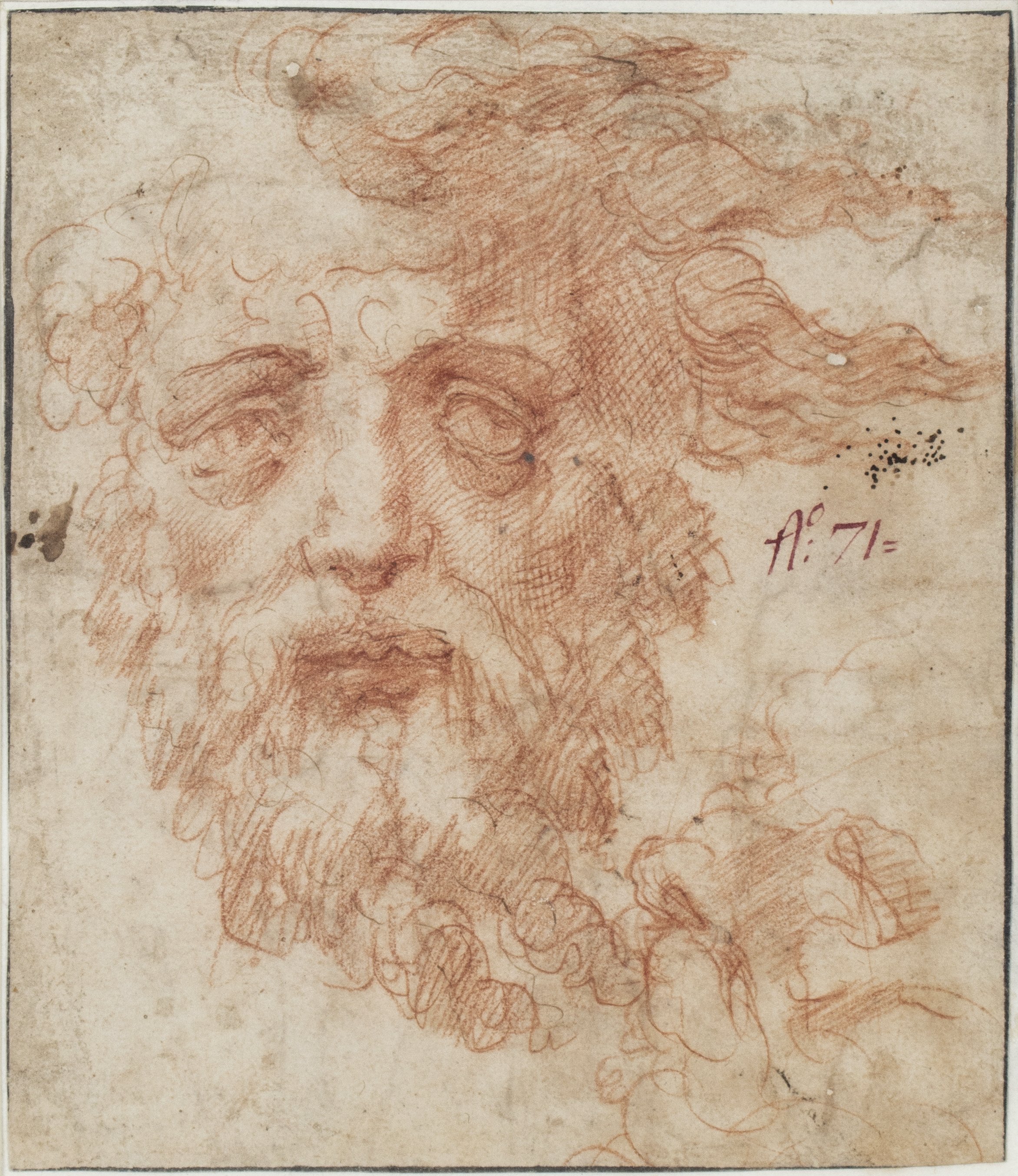
Head of a Bearded Man
Red chalk, pen and brown ink on paper
8 ⅛ x 6 ⅞ inches (20.6 x 17.5 cm)
Provenance:
Martelli Collection, Florence, by the 18th century (according to their inventory number “No: 71=” inscribed on the recto).[1]
Christie’s, London, 16 April 1991, lot 109, as Beccafumi; sold for £35,200 ($62,958) to:
Gabrielle Kopelman, New York and Pennsylvania, 1991–2025.
Literature:
Andrea Muzzi, in Disegno Italiano Antico: Artisti e Opere dal Quattrocento al Settecento, ed. Mario di Giampaolo, Milan, 1994, p. 134.
Pietro Torriti, Beccafumi, Milan, 1998, pp. 344-345, cat. no. D182, ill.
Domenico Beccafumi was the preeminent painter, sculptor, and draughtsman of Siena in the early Cinquecento. The artist’s idiosyncratic and unmistakable style marked the transition from the High Renaissance to a unique adaptation of Florentine Mannerism in his native city. Although there is no documentary evidence that he travelled to Rome, it is evident that Beccafumi had an opportunity to study the works of Michelangelo and Raphael early in his career, which laid the foundation for the agitated and incandescent works of his mature period.
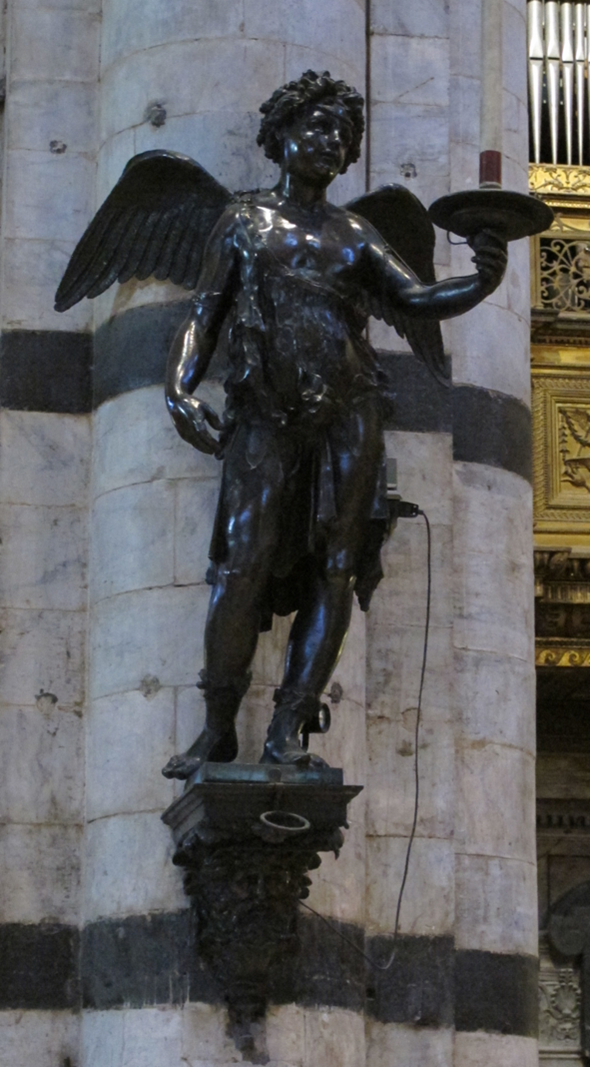
Fig. 1. Domenico Beccafumi, Angel, Siena Cathedral.
The present drawing dates from late in Beccafumi’s career and has been confidently associated with his production for Siena Cathedral. In addition to working for several decades on his celebrated pavement for the cathedral, in his final years Beccafumi delivered eight bronze angels for the piers of the nave, each facing the main altar. Our drawing is a preparatory study for one of the bearded male figures that form the base and support beneath the angels (Fig. 1). Beccafumi completed the angels in stages between 1447 and 1551. Models were produced for the first pair in March 1447; for the second pair in April 1448; and for the final four in June 1448. The final bronzes were cast in the winters of 1549 and 1550, and work likely continued up until the artist’s death, as payment for the project was not delivered by the Opera del Duomo until 1555 to Beccafumi’s widow and son.
In our drawing, the figure’s hair and beard break into loose, wind-swept strands that surge towards the right. The direction of the flow of the hair has led to the figure’s association with the bearded man on the base of the right-hand angel from the second pair produced by Beccafumi (Figs. 2-3), in which the hair similarly swoops towards the right. The drawing therefore likely dates from the spring or summer of 1547. In their fusion of human and vegetal forms with the tradition of grotesque ornament, the finished bronze bases are primarily inspired by ancient statuary. But in comparison with the bronzes, which are more restrained and controlled, our drawing is animated and puts Beccafumi’s painterly verve on full display. Furthermore, the drawing is exceptional in Beccafumi’s graphic oeuvre as one of the few (if not the only) surviving preparatory drawings for his activity as a sculptor in bronze.
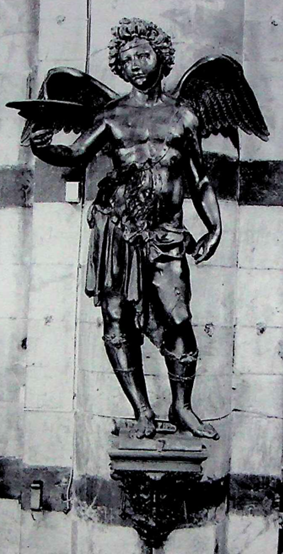
Fig. 2. Domenico Beccafumi, Righthand Angel from the second pair, Siena Cathedral.
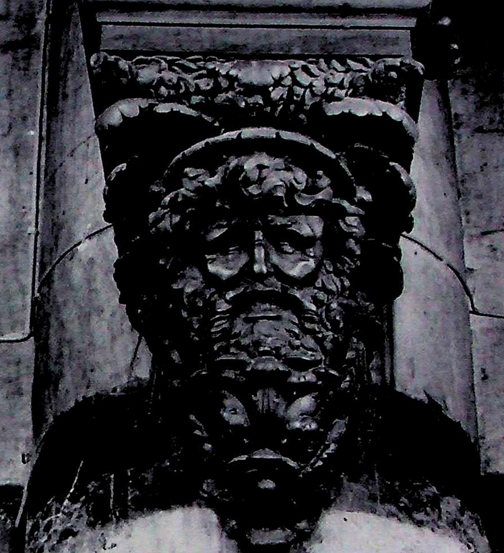
Fig. 3. Domenico Beccafumi, detail of the base for the righthand Angel from the second pair, Siena Cathedral.
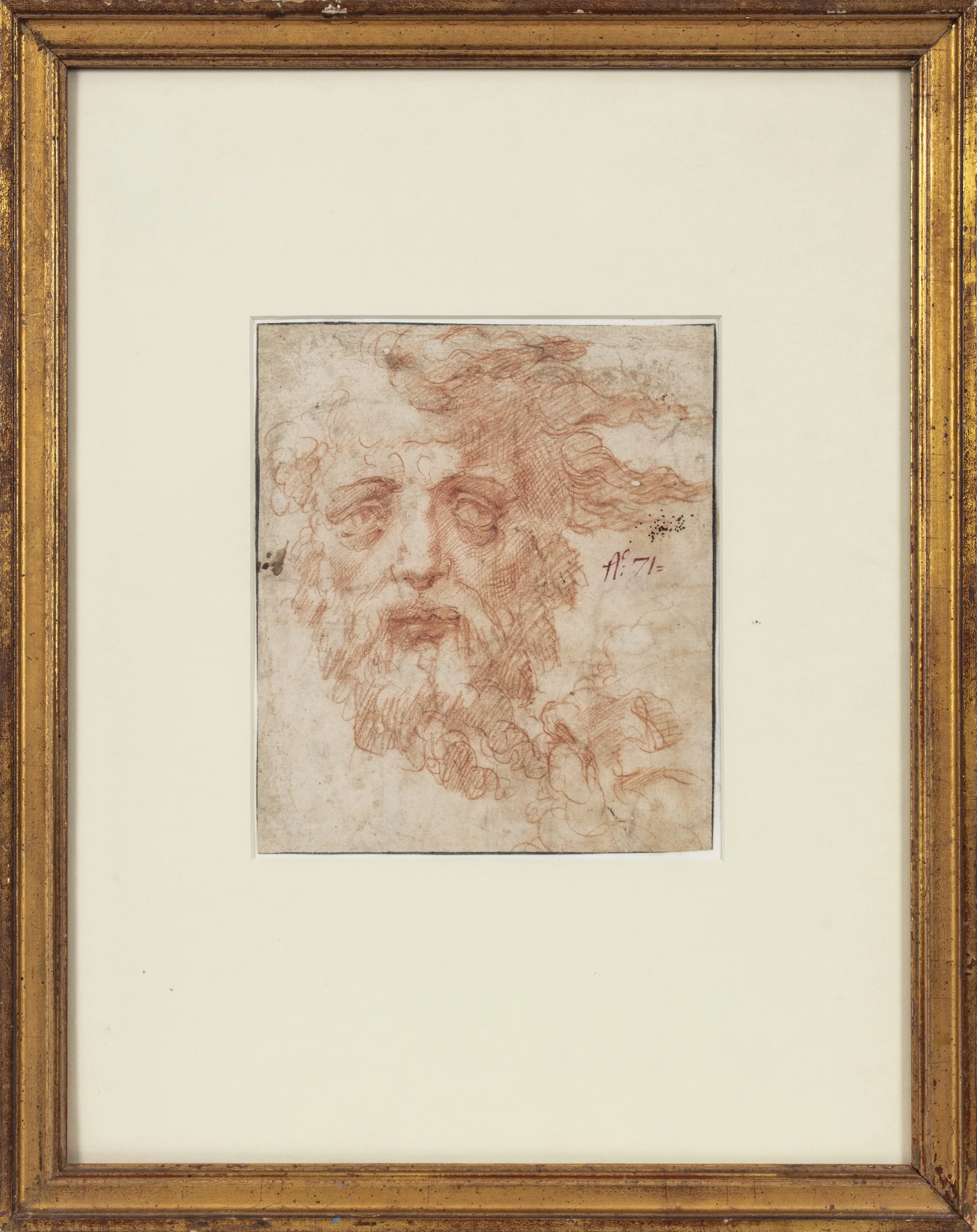
[1] When sold at Christie’s, this drawing was catalogued as perhaps previously in the collection of Lamberto Christiano Gori (1730–1801), his number in purple ink “No 71=”. As has been clarified in the online version of Frits Lugt’s Les Marques de collections de dessins & d’estampes in the 2010 update (L.1171a): “Several drawings in Gori’s collection bear a number at the top, inscribed in pen and red-violet ink, which was long attributed to Gori himself. In reality, these numbers correspond to the Florentine collection of the Martelli family (see Nicholas Turner and Paul Joannides, “Some drawings by Michelangelo and his circle in the Prado,” Boletín del Museo del Prado, vol. XXI, no. 39 (2003), pp. 8-23, especially pp. 18-21).”