
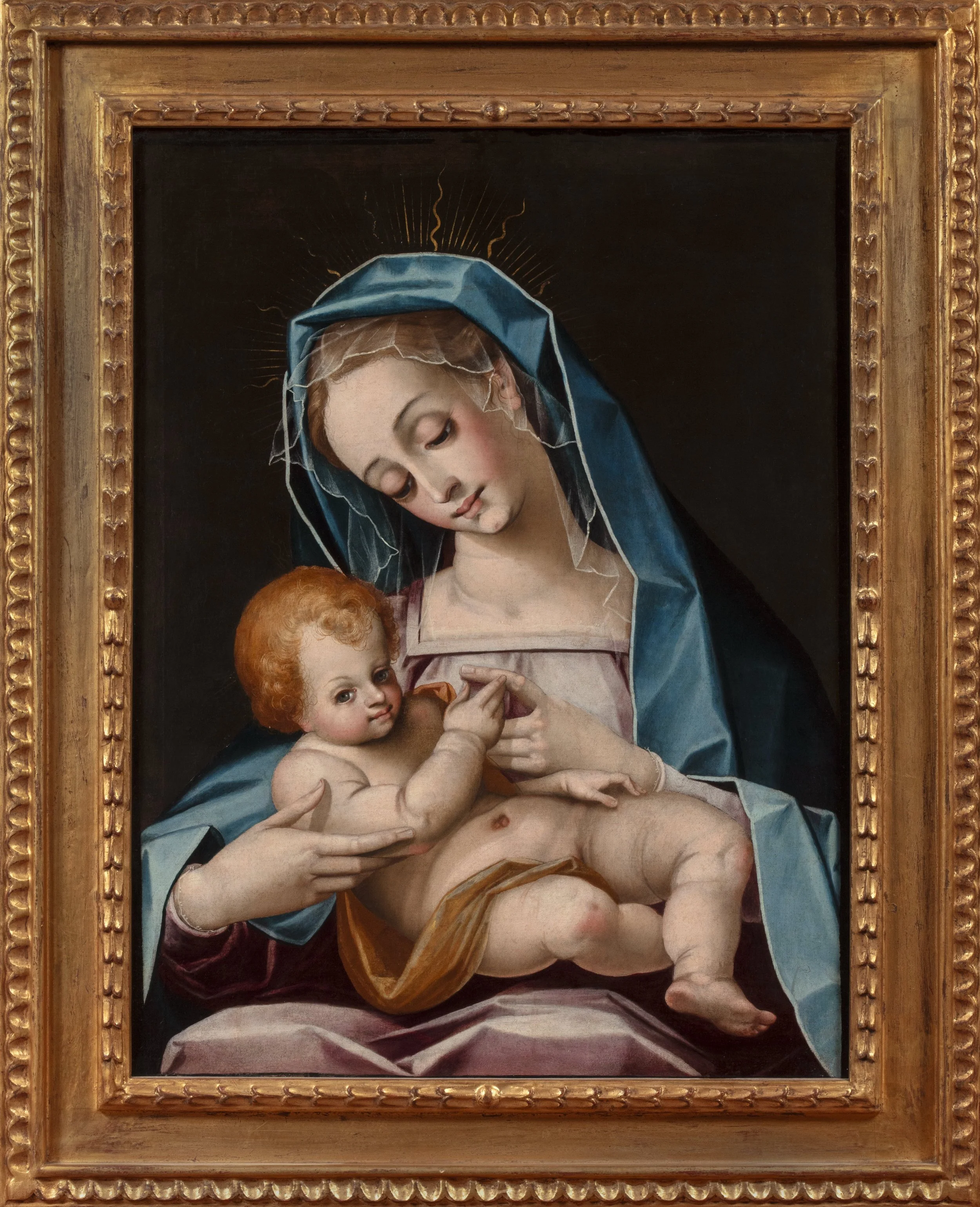
BERNARDO BITTI
(Camerino 1548 – 1610 Lima)
Madonna and Child
Oil on canvas
35 ¾ x 27 ¼ inches (90.8 x 69.2 cm)
Provenance:
Private Collection, Paraguay, acquired by the family over 80 years ago and by descent until 2023.
Bernardo Bitti occupies an important position in the history of art in Europe and the Americas. He was born in the city of Camerino in the Italian Marches and received his initial artistic training there. He completed his studies in Rome, where, at the age of 20, he joined the Jesuits on 2 May 1568 at the age of 20. As a Coadjutor Brother—essentially a layperson who could hold all roles within the order that did not pertain to the priesthood—Bitti was employed for his skills as a painter. In 1573, he was assigned by the fourth Superior General of the Society of Jesus, Everard Mercuriano, to the Viceroyalty of Peru at the request of the Jesuit Provincial in Peru, Diego Bracamante. Bracamante believed that the presence of Catholic religious imagery in Peru would assist in the conversion of the indigenous Andean peoples at the Jesuit missions. Bitti’s mission was to introduce Catholic imagery to the Andean population, which he did through his brilliant paintings in a lucid and legible style, one derived from Italian Mannerism. But his significance for the art of the Americas was broader, as he introduced European materials and techniques to a population with an already flourishing native visual tradition. The result of this fusion was the creation of what became known as the Cuzco School, with its highly ornamented canvases of religious and allegorical subjects, and the establishment of a vibrant culture of Peruvian painting that lasted until the country’s independence.
Following a fourteen-month sojourn in Seville, the young Bernardo Bitti traveled across the Atlantic and on 31 May 1575 he arrived in Peru, where he was to spend the rest of his life. He lived and worked in Lima for the first 8 years, undertaking largescale decorative programs for churches (including painting frescoes and altarpieces), as well as private devotional paintings for Jesuits and other patrons. He then set out on a peripatetic career, working for the Jesuits in the Peruvian cities of Cuzco, Juli, La Paz, Sucre, Potosí, Arequipa, and Ayacucho.
Bernardo Bitti’s works are characterized by a distinctive pastel palette, angular folds of drapery, and elegant and elongated figures with tilted heads. With two Italian painters who were to arrive a decade later—Mateo Pérez de Alesio (Matteo da Lecce) and Angelino Medoro—Bitti was responsible for introducing Mannerism to the Americas.
Our Madonna and Child is an exceedingly rare work by Bitti that has survived outside the lands of present-day Peru and Bolivia where Bitti lived and worked.Posed against a dark background and placed close to the pictorial plane, the Virgin has a monumental presence expressed through the wide span of her flowing mantle, which fills the compositional field. She inclines her head to gaze at the Christ child, who seems to float above the Virgin’s lap. He in turn peers out of the painting, directly engaging the viewer with an engaging and benevolent expression. Bitti emphasizes the tender bond between mother and child in the placement and gentle interplay of their hands. Their softly-modelled features counterbalance beautifully with the artificiality and linearity of the electric blue and pink drapery—two signature colors for the artist. Bitti’s sensitivity to materials is also clear in the Virgin’s elaborate gilt halo composed of alternating rays and flames, as well as in her diaphanous veil.
Our painting can be compared to several of Bitti’s treatments of the same theme from his maturity in Peru, particularly his full-length Virgin and Child in the Jesuit church of Arequipa (Fig. 1) and the Virgin and Child with Saint John in the Cathedral of Sucre, Bolivia (Fig. 2). As is evident in these paintings and in the present work, Bitti’s compositions display a legibility permitting the communication of their religious content to the viewer, encouraging both visual engagement and spiritual contemplation. The artist’s highly personal Mannerist style anticipates the idealized and formalized compositions and iconographies that would come to define New World painting.
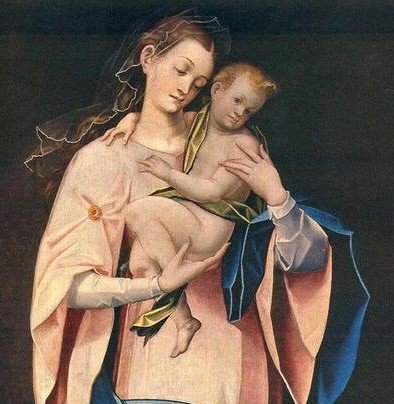
Fig. 1. Detail of Bernardo Bitti, Virgin and Child, Church of the Compañía de Jesús, Arequipa, Peru.
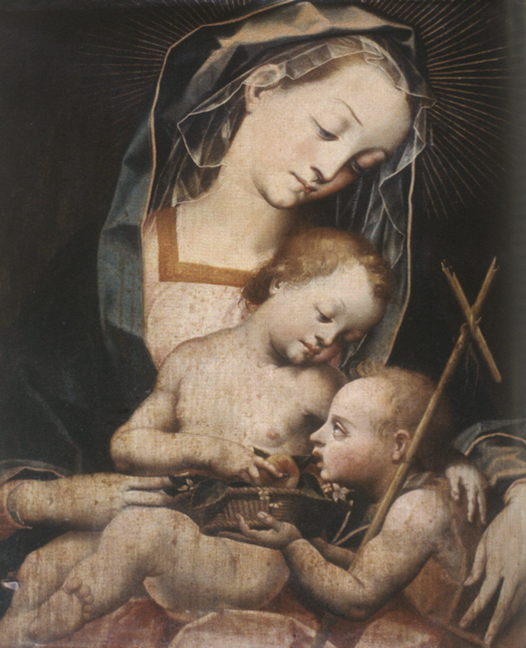
Fig. 2. Bernardo Bitti, Virgin and Child with Saint John the Baptist, oil on canvas, Cathedral of Sucre, Bolivia.
Bitti is among the few European artists who traveled to the Americas in the 16th-century, and he is generally considered to be the founder of what came to be known as the Cuzco School of painting. His body of work—from the large-scale works that have remained in situ in Jesuit churches to smaller private commissions—had a profound influence on the next several generations of painters in Peru. He trained and collaborated with indigenous painters (including Gregorio Gamarra and Pedro Bedón, who emulated and promulgated his distinctive style), and his paintings became a principal reference point in the development and proliferation of the art of painting in the viceroyalty. Despite his importance for the origin and flourishing of painting in the New World, Bitti is not well-known in his home country of Italy or in North America. His works are exceedingly rare and are represented in very few private or institutional collections outside of Peru, and many of his ecclesiastical commissions in Peru have been lost to earthquakes.