
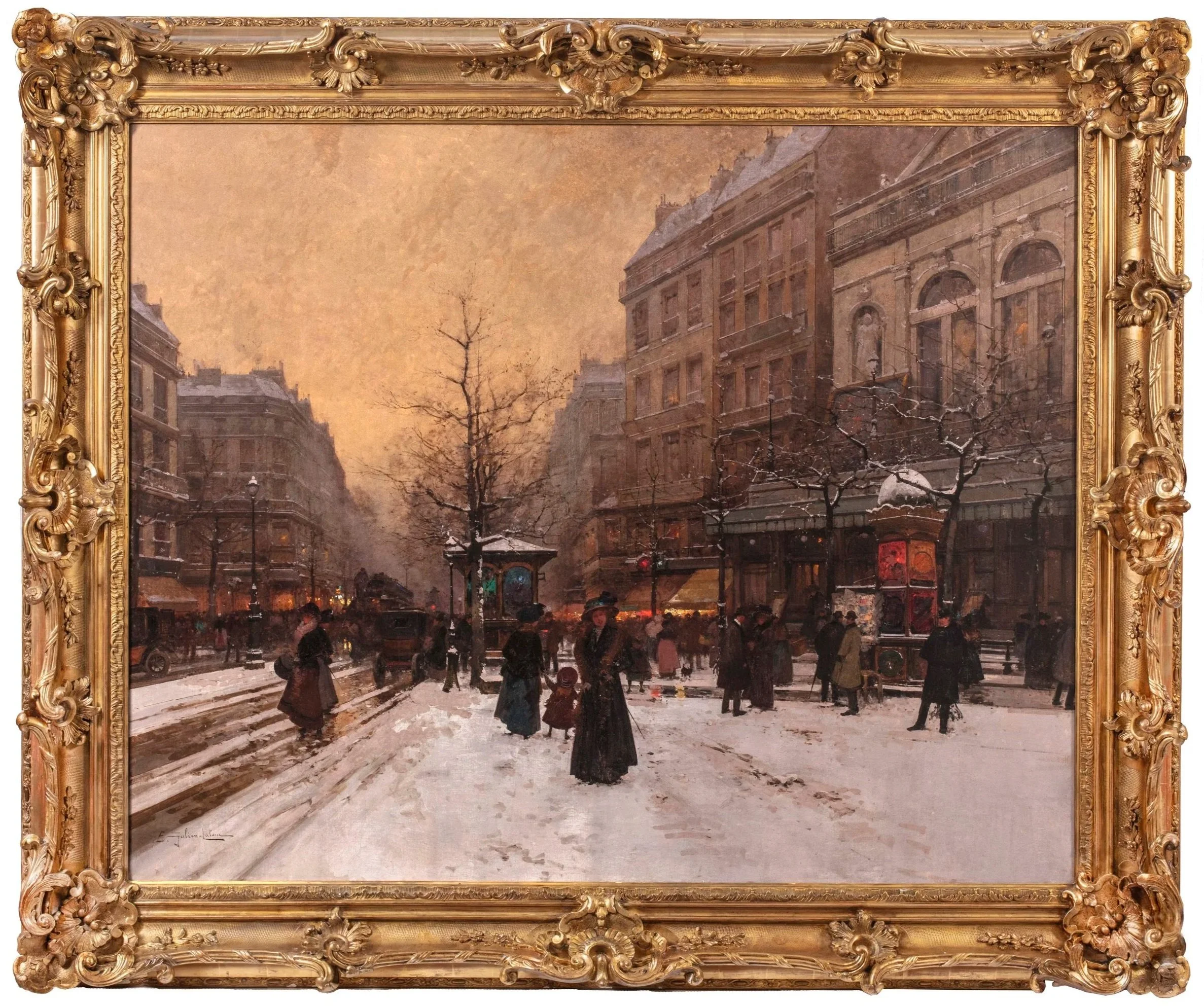
EUGÈNE GALIEN LALOUE
(Paris, 1854 – 1941)
Paris in Winter:
Boulevard Bonne Nouvelle at the Théâtre du Gymnase
Signed, lower left: E. Galien-Laloue
Oil on canvas
50 ¼ x 63 inches (130 x 160 cm)
Provenance:
Mr. Augusto Maggiolo Cavenecia, Lima, Peru, by the 1960s–2025.[1]
The French painter Eugène Galien Laloue was a champion of the Belle Époque Parisian cityscape.[2] Our monumental canvas—almost certainly the artist’s largest and most impressive work—is a quintessential example of his depictions of the City of Light. Focusing on street scenes filled with fashionable Parisians, Galien Laloue’s works evoke the order and beauty of the city. They also frequently reference the theatrical premieres and musical performances that characterized the way of life of the beau monde. The present painting centers on one such venue, the Théâtre du Gymnase on the Boulevard Bonne Nouvelle.
Capturing a moment at early dusk, Laloue balances a cold winter’s night by the introduction of a rich, warm glow from a kiosk in the foreground and shop windows beyond. The snowy sidewalk offers an ideal contrast to the garments worn by the elegantly silhouetted pedestrians in the foreground, while the sky emphasizes the spindly winter branches of the trees. Working on a grand scale, Galien Laloue’s composition also emphasizes the handsome buildings lining the broad Boulevard Bonne Nouvelle, lightly dusted with snow.
Tasked with renovating central Paris by Napoleon, Georges-Eugène Haussmann, the prefect of the Seine from 1853 until 1870, introduced leafy squares, wide boulevards and stately facades that characterize the city still today. Haussmann’s urban planning and design informed the Belle Époque image of Paris so meticulously and faithfully rendered here by Galien Laloue.
[1] Augusto Maggiolo Cavenecia was the founder of an important shipyard in Lima, Perú, as well as a racehorse breeder. He had a famous horse named Santorín that won the Derby in Peru and in Argentina in 1973.
[2] Galien Laloue used several pseudonyms in his professional life, including J. Lievin, E. Galiany and L. Dupuy, perhaps to gain some freedom from an exclusive contract with a gallery.