
KONGO KINGDOM, 18th Century
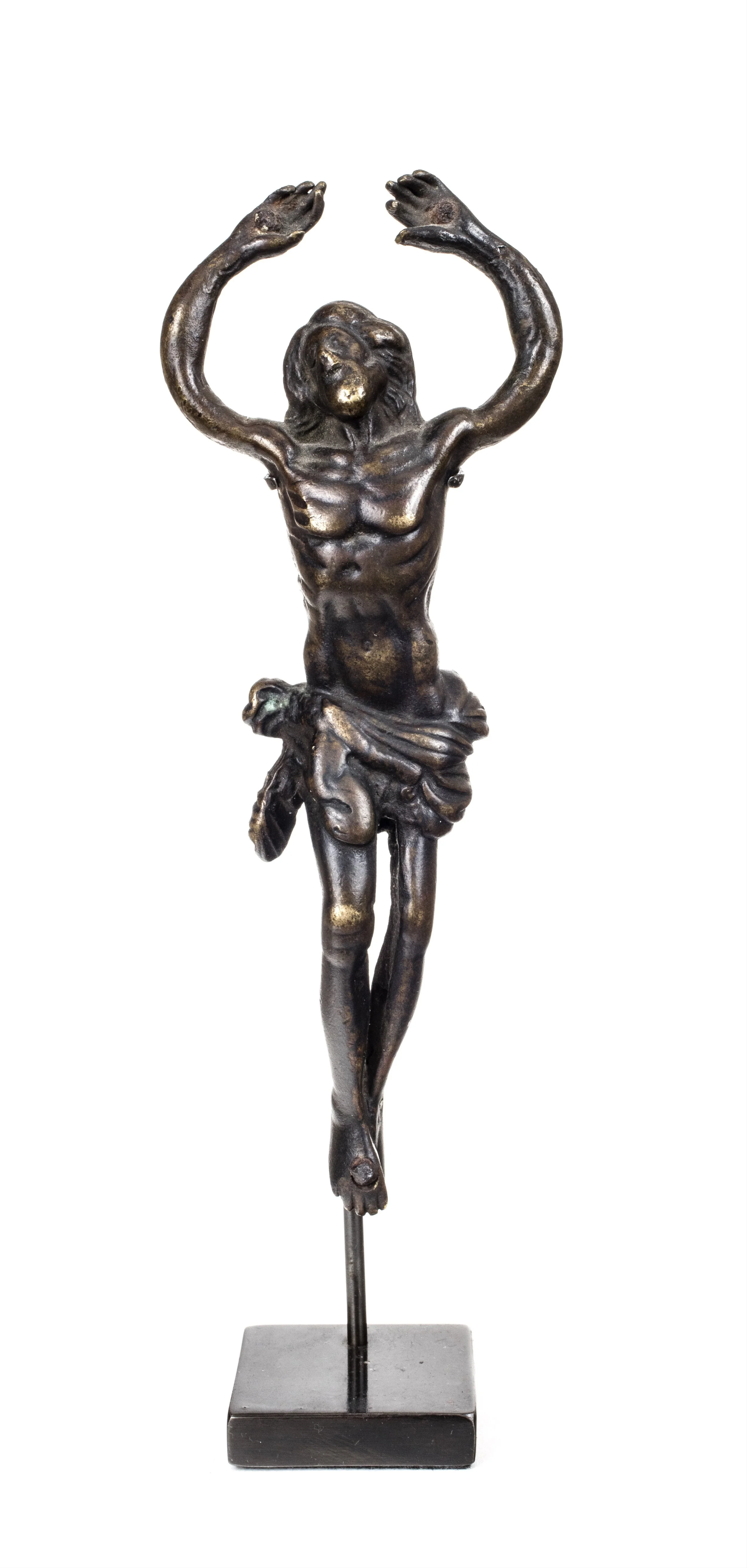
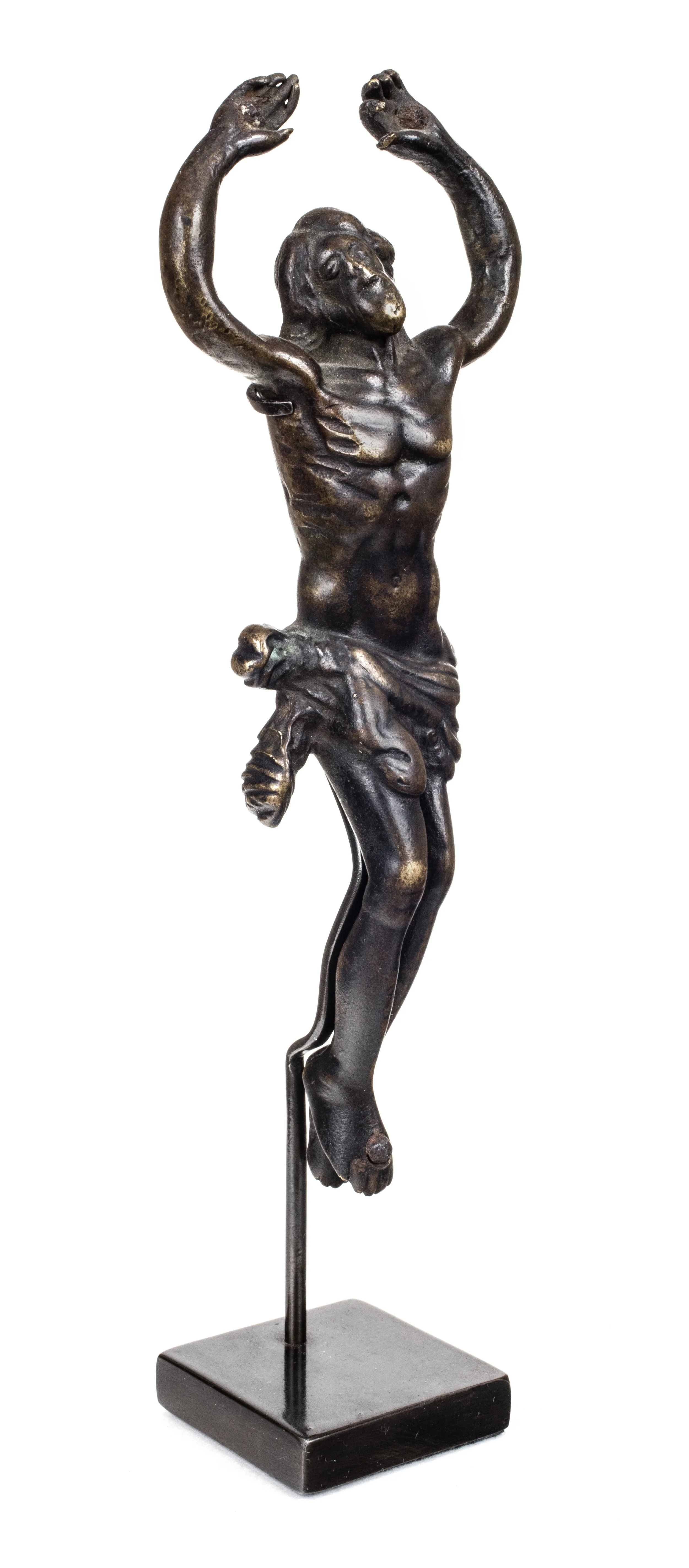
Christ Crucified
Brass
6 x 2 ¼ inches (15.2 x 5.6 cm)
7 3/8 inches tall on base
Provenance:
Charles Ralet, Belgium; by whom acquired in Bas-Congo before 1948; by descent in the Ralet family until 2020; from whom acquired by:
Private Collection, Paris, until 2025.
Exhibited:
Royal Museum for Central Africa in Tervuren, Belgium, on long-term loan from 1948–1960.
This expressive figure of the Crucified Christ, produced in the Kongo Kingdom during the 18th century, is a compelling expression of Christian iconography transformed through a distinctly Central African lens.[1] Cast in brass using the lost-wax technique—a sculptural tradition long established in West and Central Africa—the work reflects both a local mastery of form and a sophisticated adaptation of imported religious imagery. Despite its recognizable iconography, the work departs from the European crucifixes on which it was modeled. Christ’s dramatically curved arms, raised high above his head, may evoke indigenous Kongo sculptural modes, such as those employed in nkisi nkondi (power figures) and other ritually potent figural forms, in which gesture functions as a vehicle of spiritual agency.
Christianity was first introduced to the Kongo Kingdom in the late 15th century through sustained contact with Portuguese missionaries and traders, and it became deeply embedded in royal and elite identity. By the 18th century, Christian imagery developed distinct material expressions. Brass crucifixes were not merely liturgical objects but also potent symbols of political authority, personal devotion, and ancestral mediation. Their portability and durability lent them special significance in a society where visual objects played a central role in spiritual life. Kongo crucifixes circulated among court officials and clan leaders, often serving as markers of legitimacy, spiritual protection, and access to divine intercession.
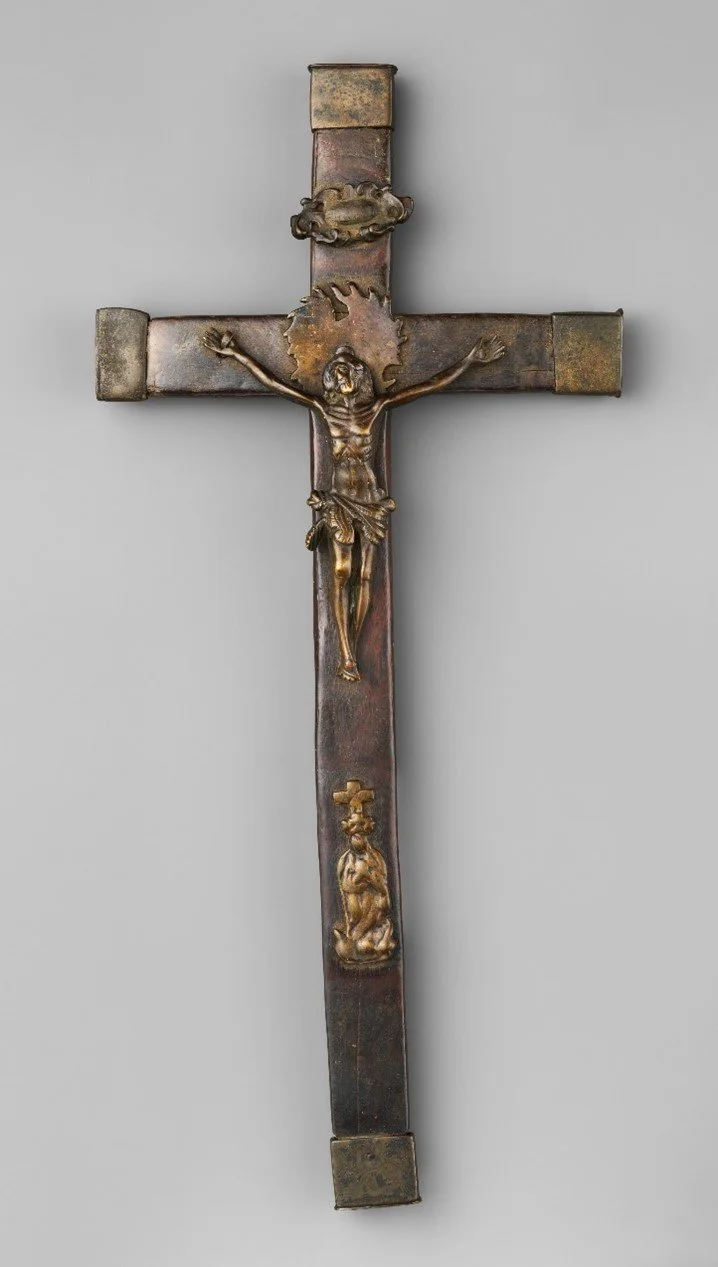
Fig. 1. Kongo Kingdom, 16th–17th Century, Crucifix, brass, Metropolitan Museum of Art, New York, inv. no. 1999.295.8.
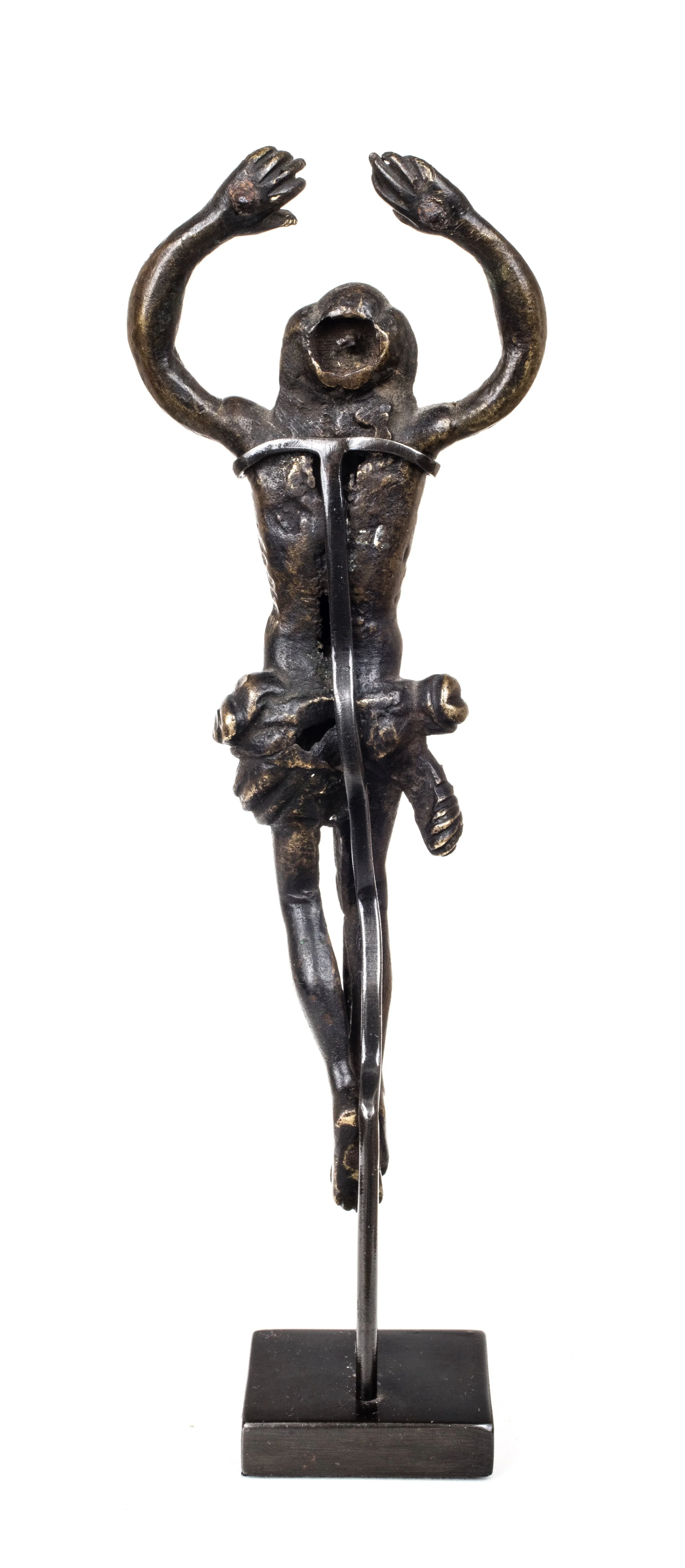
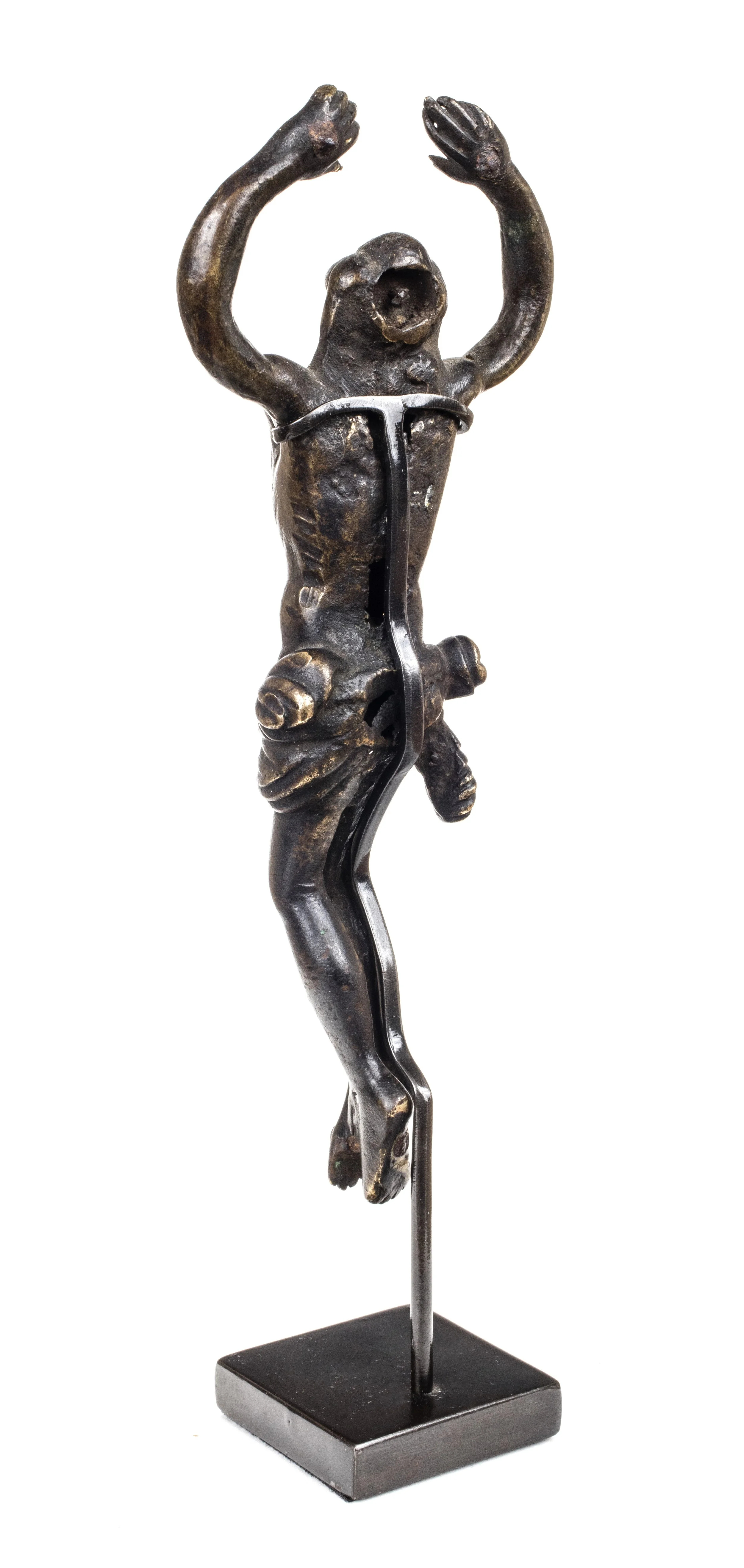
Our Crucified Christ was likely originally attached to a brass cross. As was typical, the figure was cast in a mold using metal obtained from a traditional African brass currency known as manillas, a term derived from the Portuguese word for hand-ring, reflecting the bracelet form that this currency often took. Used as early as the 1400s in mercantile transactions in West Africa, manillas notoriously became the primary medium of exchange in the slave trade when Europeans discovered the importance of copper, known as “red gold,” in West African commerce. As a raw material, brass from manillas also found its way into decorative and devotional objects produced locally, like the present work. After casting, our Crucified Christ was subsequently incised with finer details. The scale of the sculpture suggests that it may have originally functioned as a handheld devotional object or status emblem. The expressive face, stylized features, and flowing perizoma find close comparables in a Kongo crucifix in the collection of the Metropolitan Museum of Art dated to the 16th or 17th century, which suggests that our work may have been produced earlier than previously thought (Fig. 1).
Kongo crucifixes stand as material testaments to a deeply entangled history of cultural encounter, artistic exchange, and religious syncretism. Christian visual culture was not passively received but actively reimagined in Africa—rendered local, legible, and operative within the spiritual landscape of the Kongo. In the Kongo Kingdom, the form of the cross was not a foreign sign but a deeply embedded cosmological symbol. Long prior to and independent of the arrival of Christians, cruciform motifs encoded the dikenga or “the Four Moments of the Sun” (dawn, noon, dusk, and midnight)—a schema that represented life, death, spiritual transformation, and rebirth. The convergence of Christian crucifixes with this symbol of the indigenous belief system enabled a particularly resonant fusion of spiritual meaning and visual form. In this context, Kongo crucifixes operated not only as emblems of Christ’s Passion, but as ritual charms that invoked protection and ancestral intercession.
The present sculpture once formed part of a significant collection of Kongo Kingdom crucifixes and related Christian imagery assembled by Charles Ralet (1896–1971). They were likely all acquired during his second trip to Congo—then a colony of Belgium—in 1947. In the following year, Ralet lent 27 works from this collection to the Royal Museum for Central Africa in Tervuren. Each of these are marked on the reverse with an inventory number from the museum starting with “D-Ral” (an abbreviation of dépôt and Ralet) and a number. Ours is faintly marked on the reverse as number 24 from this group. Several works from the Ralet collection were acquired by the museum, while others were returned to him in 1960 and passed down by descent in his family, including this work, which recently emerged from their collection.
[1] The Kingdom of the Kongo (Kongo Dya Ntotila or Wene wa Kongo) occupied land encompassing part of present-day northern Angola, the western area of the Democratic Republic of the Congo, southern Gabon, and the Republic of the Congo. The Kingdom, notable for its early adoption of Christianity, was an independent state from ca. 1390 until 1914, though under Portuguese rule after 1862.