
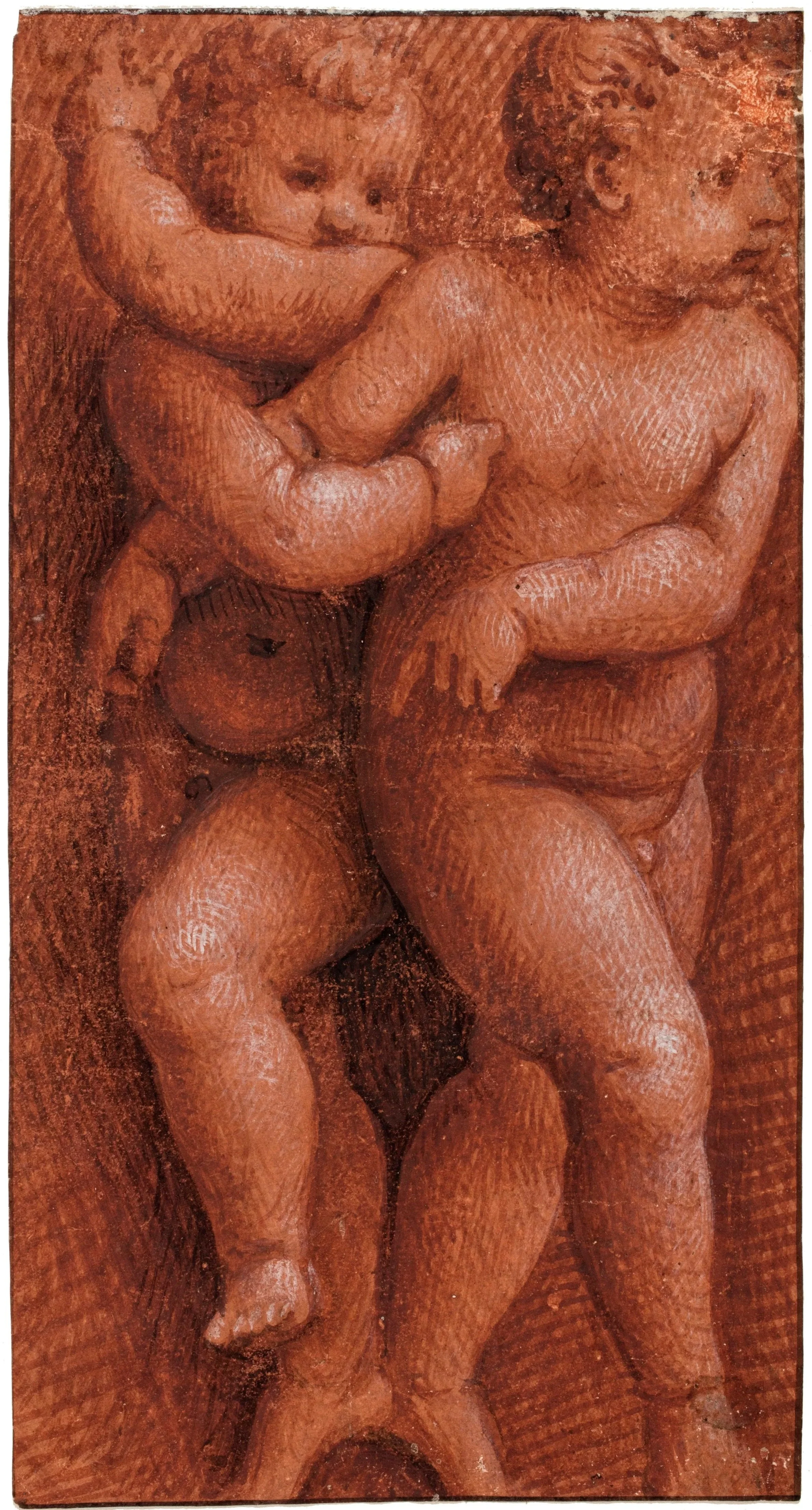
Workshop of Bernardino Luini
(ca. 1480 – ca. 1532)
Two Putti
Pen and ink with white heightening on orange prepared paper
9 ⅛ x 4 ⅞ inches (23.2 x 12.4 cm)
Provenance:
Wilhelm Suida, New York, until 1959; by descent to:
Suida-Manning Collection, New York, 1959–1996
Private Collection, USA, 1996–2025.
Bernardino Luini was one of the most important exponents of Lombard painting in the following of Leonardo Da Vinci. The influence of Leonardo’s Milanese period is particularly felt in Luini’s works, not only in his choice of motifs but also in the sfumato contours and characterization of his figures. This sensitively modeled drawing from the workshop of Luini depicts two putti with their arms intertwined and each gently lifting a foot as if in midstride. Executed in pen and brown ink on a rich orange prepared paper, the present sheet is a fine example of Luini’s graphic idiom.
Drawings of young children—especially in a vertical, compact format—were frequently made by Luini and his workshop assistants as compositional studies for the principal characters and peripheral figures in altarpieces, frescoes, and private paintings. The Christ Child and the young Saint John the Baptist, as well as the playful putti that abound in his paintings, were signature characters of Luini’s artistic output. Here the tender interaction of the two putti—one glancing off the page to the right while the other clutches his companion from behind—is enhanced by the volumetric modelling of bodies, which lends them a sculptural quality. The putti find a close cognate in Luini’s Christ Child as Salvator Mundi in the Biblioteca Ambrosiana (Fig. 1).
The present drawing is an unpublished work, long held in the private collection of the art historian Wilhelm Suida and his descendants.[1] The work offers a significant window into the diffusion of Leonardo’s influence in Northern Italy and is a testament to the enduring appeal of Bernardino Luini’s visual language.
[1] While Suida published extensively on Leonardo Da Vinci and his followers (“Leonardo da Vinci und seine Schule in Mailand” in Monatshefte für Kunstwissenschaft, 1919; and Leonardo und sein Kreis, Munich, 1929), but he did not publish this drawing in his collection.
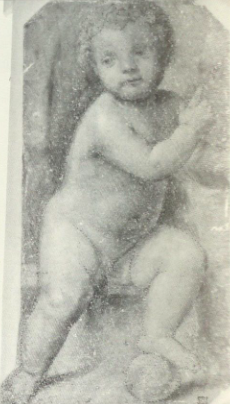
Fig. 1. Bernardino Luini, Christ Child as Salvator Mundi, Biblioteca Ambrosiana, Milan.