
FRANCESCO LUPICINI
(Florence 1591 – ca. 1656 Zaragoza)
The Triumph of David
Oil on canvas
59 ⅝ x 59 inches (151.5 x 150 cm)
In a magnificent carved and gilt Florentine frame,
75 x 75 inches (190.5 x 190.5 cm)
Provenance:
Private Collection, Spain, until 2025.
Francesco Lupicini is one of the most enigmatic figures of Florentine Baroque painting. His artistic lineage was distinguished, having been the nephew of Cristofano Allori (with whom he trained and later collaborated) and the student of Matteo Rosselli. And yet it is only recently that his distinctive style has been recognized and his career reconstructed, if only in part. The reasons for this are varied. First, he left his native city for Spain in 1636 and was thus not personally known to Florentine biographers such as Baldinucci. Moreover, many of his paintings had over the years been confused with those of Giovanni Battista Lupicini, likely an elder brother. That his name appears several times in Florentine lawsuits in the years 1625–1635 supports his reputation as being quarrelsome and litigious, but provides little insight into the chronology of his work.
Lupicini’s figures are sensuous and subtle, characterized by soft modeling, an emotional reserve, and a delicate palette—evident both in single figures, such as these two canvases in American museums (Figs. 1-2), and in multi-figural compositions. Perhaps the most celebrated multi-figural work is his Martha Rebuking Mary Magdalene for her Vanity in the Kunsthistorisches Museum (Fig. 3), a work acquired by Archduke Leopold Wilhelm, having previously been in the collections of the Duke of Hamilton and Nicholas Regnier.
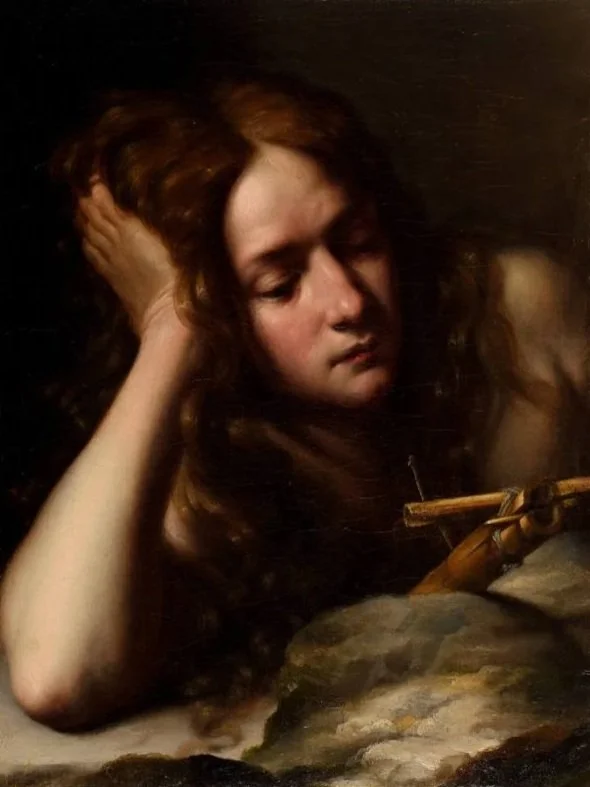
Fig. 1. Francesco Lupicini, Mary Magdalene, Palmer Museum of Art, Pennsylvania.
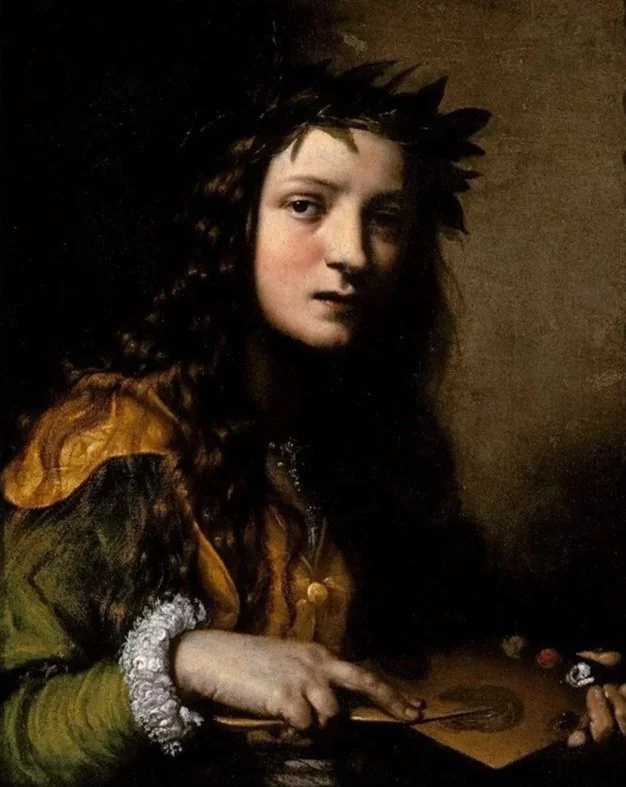
Fig. 2. Francesco Lupicini, Allegory of Painting, Columbia Museum of Art, South Carolina.
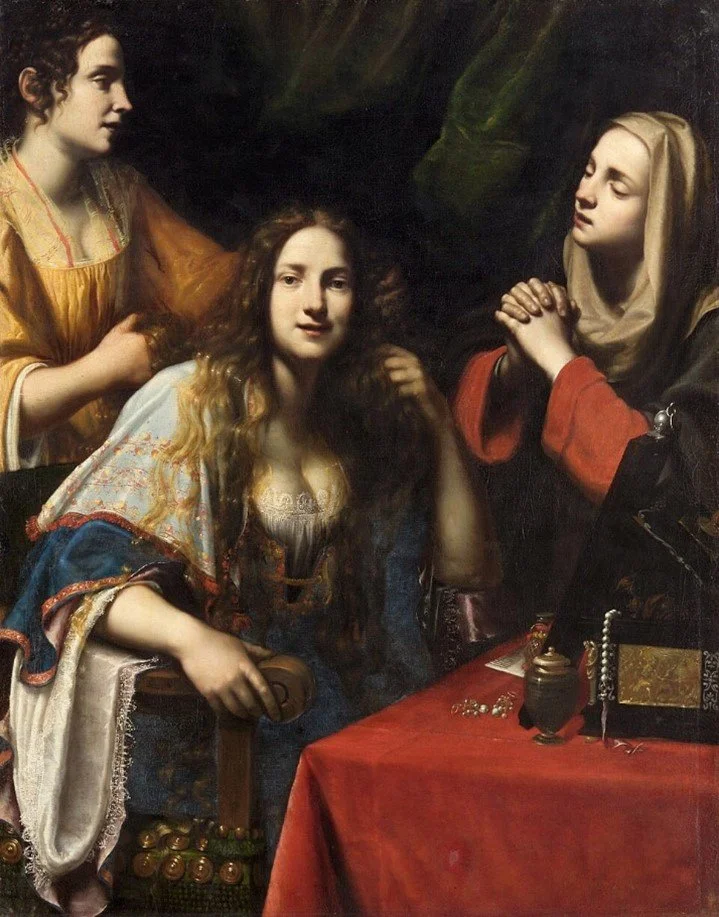
Fig. 3. Francesco Lupicini, Martha Rebuking Mary Magdalene for her Vanity, Kunsthistorisches Museum, Vienna.
Our Triumph of David depicts the young biblical hero jubilantly returning from battle having defeated the Philistines. As related in the first Book of Samuel (18:6-7), “the women came out of all cities of Israel, singing and dancing, to meet king Saul, with tabrets, with joy, and with instruments of musick. And the women answered one another as they played, and said, Saul hath slain his thousands, and David his ten thousands.”
Lupicini’s painting is one full of motion and music. David strides forward at center, having climbed a hill as his dress billows in the wind. He is holding the out-sized sword of Goliath against his shoulder, the weapon used to decapitate the giant Philistine warrior who was memorably felled by a stone hurled from David’s sling (still draped across his shoulder). David’s right hand is entwined with Goliath’s hair from which the inanimate head, marked by a large oval wound, hangs against his leg.
David is accompanied by the rejoicing Israelite women, the two most prominent standing beside him, both looking admiringly at the conquering hero. The one at right beats a tambourine (the biblical tabret), while the other holds aloft an “Alla Turca” triangle (with rings) with her left hand as she is poised to strike it with the beater held in her right. Between and behind them more women climb the hill, variously singing and playing instruments—visible are a flute, a lira da braccio, and a lute.
David was to the Florentines a symbol of strength and independence, and he was celebrated with sculptures by Donatello, Verrocchio, and, most famously, Michelangelo. He was also an exemplar of youthful male beauty, an aspect exploited by 17th-century painters, Caravaggio among them. Among Florentine painters Lupicini’s master Matteo Rosselli achieved fame with several variant treatments of the Triumph of David. The earliest, finished before 1620, was a commission for Cardinal Carlo de’ Medici, a large canvas now in the Galleria Palatina in Florence (Figs. 4-5).[1] Another version, signed and dated 1630, is in the Louvre, while other examples are in the Galleria Corsini in Florence and at Kedleston Hall (National Trust) in Derbyshire.
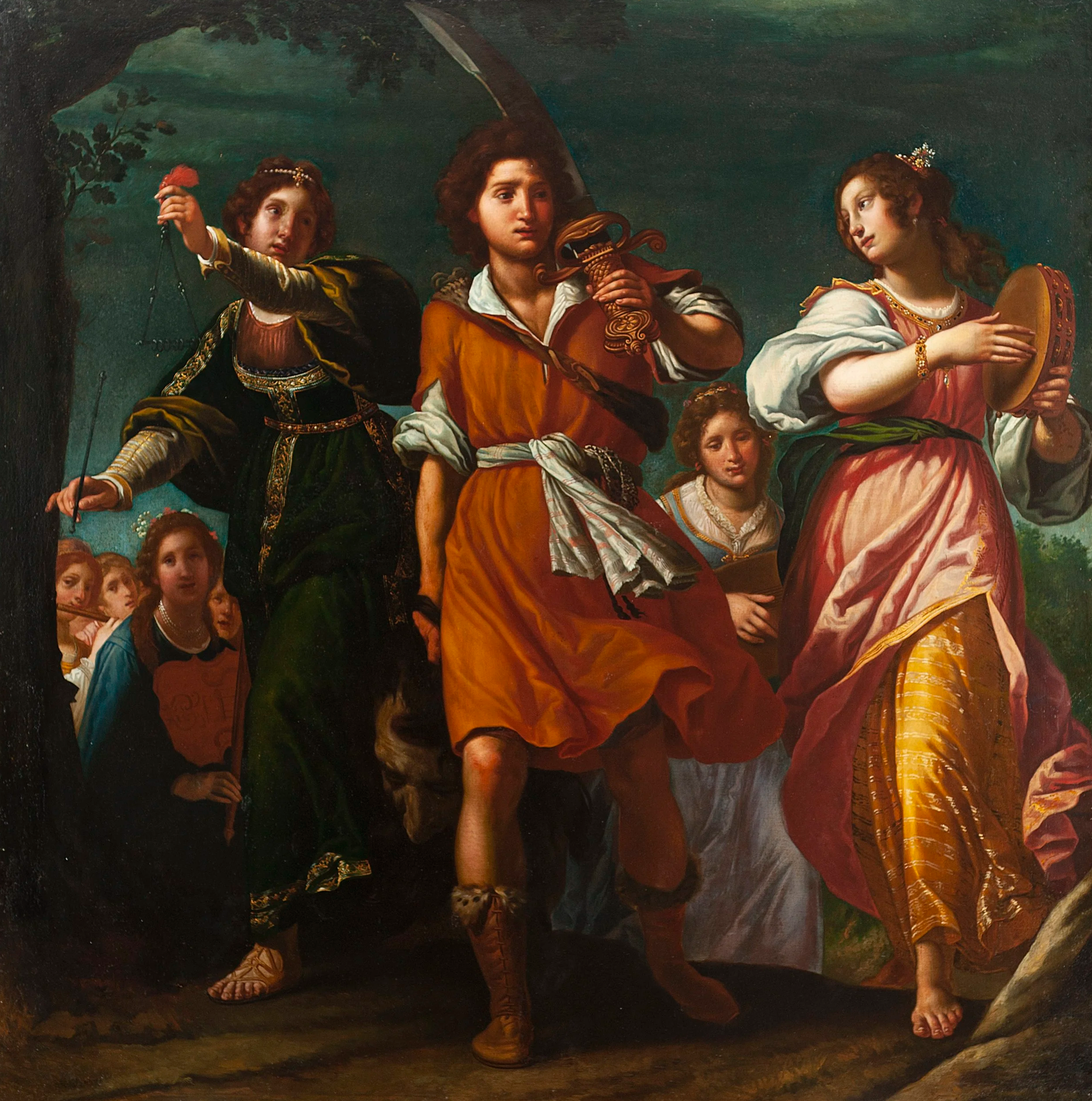
Fig. 4. The present work.
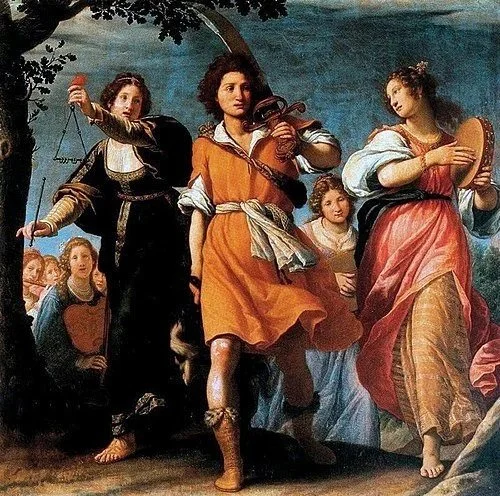
Fig. 5. Matteo Rosselli, Triumph of David, Palazzo Pitti, Florence.
Although of smaller dimensions, Lupicini’s painting faithfully follows the format and composition of Rosselli’s, while now setting the scene in the evening with only minor variations in details and palette (for example, the blouse of the woman at left has gone from white to red). The most striking differences are to be found in the characterization of the figures, reflecting Lupicini’s style with its heightened use of chiaroscuro. The triumphant protagonist seems to have become somewhat conflicted, a “melancholic hero,” in Francesca Baldassari’s words.[2] David reappears in similar fashion in Lupicini’s slightly later painting of David and Goliath (Fig. 6).[3]
Baldassari dates our painting to Lupicini’s brief Florentine period, between 1625 and 1635, prior to his departure for Spain, where he was to remain for the rest of his life, principally in Zaragoza. That the present work, still in in its original Florentine frame, comes from a Spanish collection suggests that it may have accompanied the artist on his departure from Italy.[4]

Fig. 6. Francesco Lupicini, David and Goliath, Private Collection.
[1] Galleria Palatina no. 13, oil on canvas, 203 x 201 cm.
[2] See Francesca Baldassari’s entry on the present painting, dated 13 November 2025, which is available upon request.
[3] Copper, 30.5 x 24.5 cm. Formerly with Rob Smeets, Geneva. See: Francesca Baldassari, A Masterpiece of the Florentine Seventeenth Century: Francesco Lupicini’s David and Goliath, Perugia, 2016.
[4] A recent monograph on the artist provides much information on the artist’s career in Spain. See: Álvaro Vicente Romeo, Francesco Lupicini, Caballero Noble Florentín: Un Pintor Entre La Toscana y Aragón (1591 – h. 1656), Tarazona, 2024.