
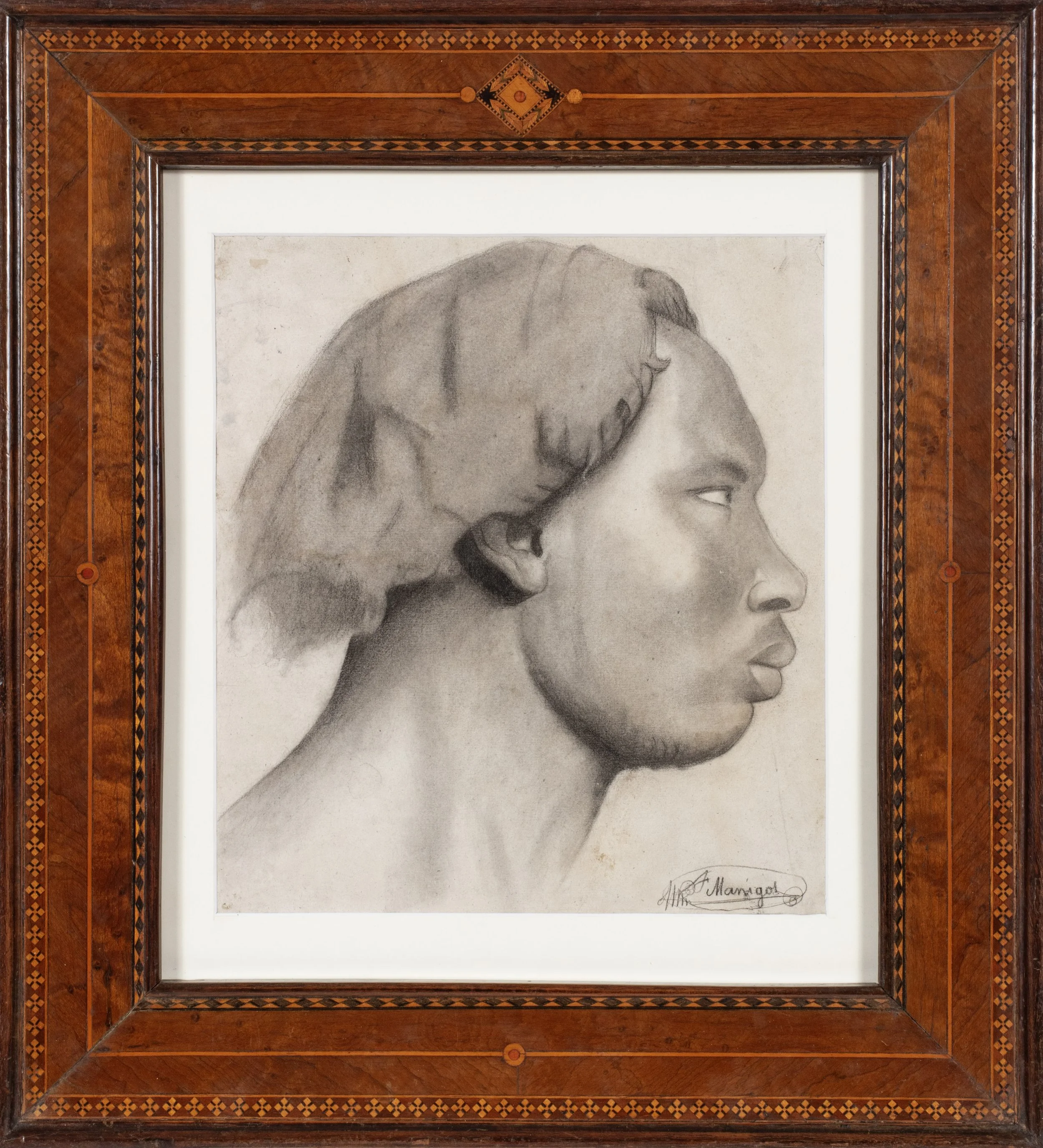
A. MANIGOT
(French, 19th Century)
Profile Portrait of a Man
Signed, lower right: A. Manigot
Black chalk on paper, 12 x 11 inches (30.5 x 27.9 cm)
Framed dimensions, 20 ⅛ x 18 ¼ inches
Provenance:
Private Collection, Italy, until 2026.
The full name of the artist of this striking drawing remains unknown. Besides the present work, “A. Manigot” is known as a sculptor working in bronze with the famed French bronze caster (“fondeur”) Ferdinand Barbedienne (1810–1892). Most of Barbedienne’s production consisted of small versions of celebrated sculptures. While some of these were produced mechanically, others were translated into their more domestic (and commercial) formats by trained sculptors, of which Manigot was one. Among the Barbedienne bronzes that Manigot signed were Antonin Mercié’s Gloria Victus and David avant le Combat, Houdon’s Seated Voltaire, and Vincenzo Vela’s Last Days of Napoleon.
The present drawing is an uncompromising study of an African man in profile. As we know nothing of the artist’s biography, it is impossible to say where the artist might have drawn it, but considering the presence of many Black models in 19th century Paris, it may well have been done there.[1] What is noteworthy in the present work is the artist’s quest to record with absolute fidelity (and, notably, without exaggeration) the features of his subject: the intensity of his gaze, the wisps of beard under his chin, and his proud and resolute expression. The drawing is that of an individual, not a stereotype, and although his name is unknown to us, he remains a knowable presence.
[1] The subject of the recent exhibitions, “Posing Modernity: The Black Model from Manet and Matisse to Today” at the Wallach Art Gallery of Columbia University in New York and “Black Models from Géricault to Matisse” at the Musée d’Orsay in Paris.