
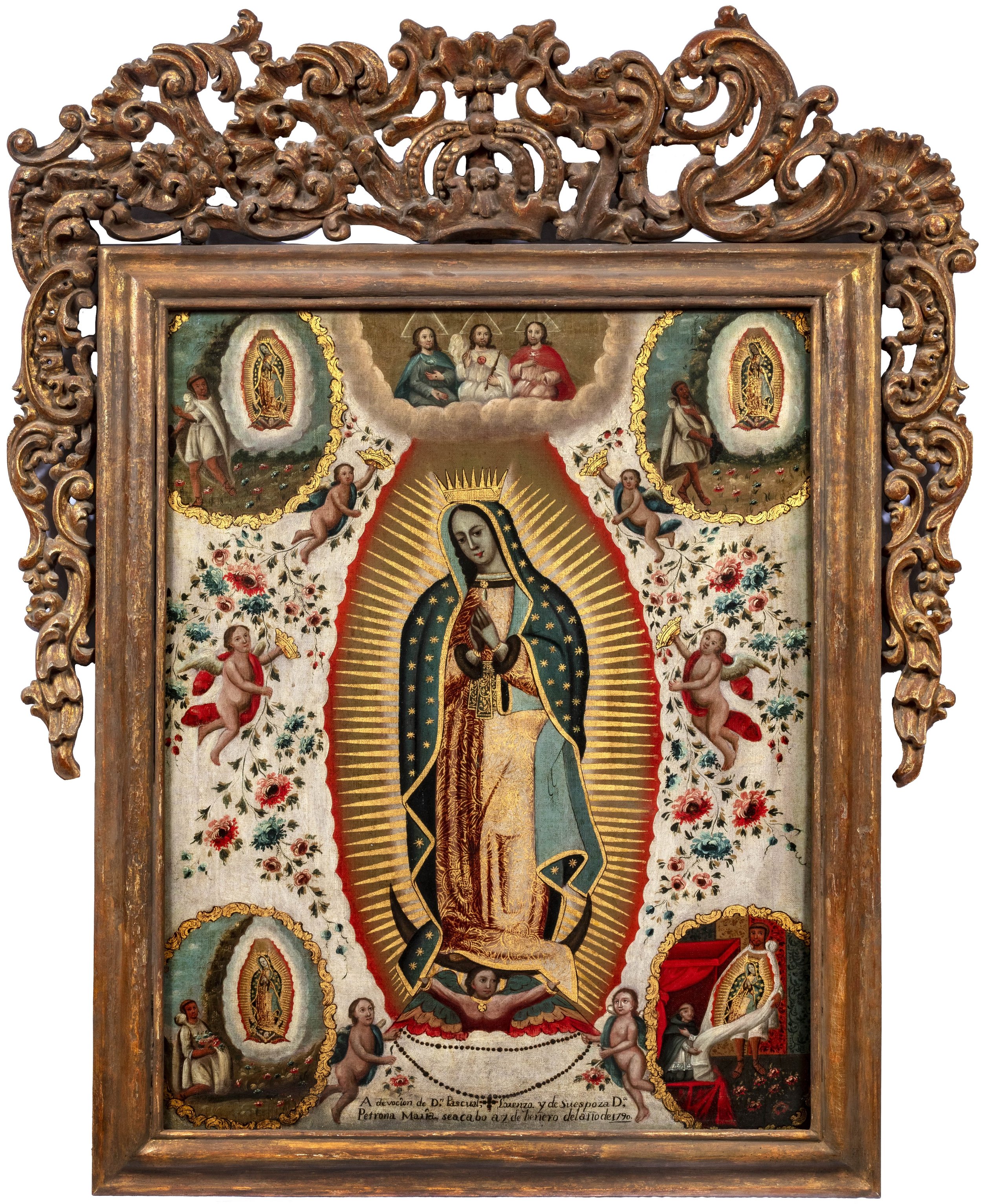
MEXICAN SCHOOL, dated 1790
Virgin of Guadalupe
Inscribed and dated, lower center:
A devocíon de D,ⁿ Pascual, Lorenzo. y de Su espoza D,ᵃ /
Petrona Maria. se acabo a 7 de henero del año de 1790.
Oil on canvas
33 ¼ x 25 inches (84.5 x 63.5 cm)
Provenance:
Private Collection, Suinaga family, Mexico, probably since the 18th century; brought by the family to Houston, TX ca. 1910–1920 during the Mexican Revolution; and by descent to the great-granddaughter, Vail, Colorado.
This impressive painting depicts one of the most popular subjects of Spanish Colonial, and particularly Mexican, painting: the Virgin of Guadalupe. Paintings of the Virgin of Guadalupe record the 1531 vision of Juan Diego Cuauhtlatoatzin (often referred to simply as Juan Diego), a Chichimec peasant and Christian convert. According to the legend, the Virgin Mary appeared as a young dark-skinned woman to Juan Diego and spoke to him in his native Nahuatl tongue. The cult of the Virgin of Guadalupe spread rapidly in the New World, particularly among the population of recently converted indigenous people. That the Virgin spoke in a local language and was physically similar to the native inhabitants of the Valley of Mexico was viewed as confirming the spiritual worthiness of indigenous Americans and underscoring the universality of Christianity. Today, the Virgin of Guadalupe is venerated worldwide.
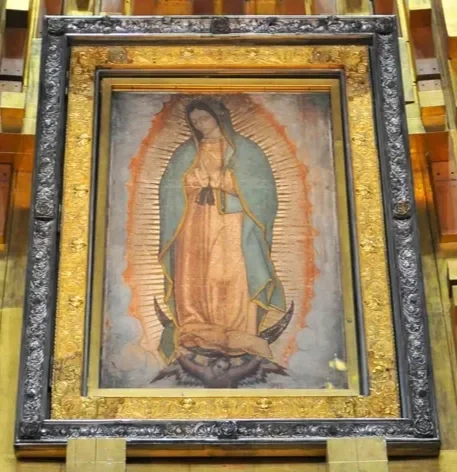
Fig. 1. Juan Diego’s tilmatli with the imprint of the Virgin of Guadalupe, Basilica of Santa María de Guadalupe, Mexico City.
The gold-leaf trimmed vignettes that appear in the four corners of the composition depict events associated with her miraculous appearance. The first (at upper left) shows Juan Diego hearing his name being called while on his way to mass in a church outside Mexico City. A young woman appeared before him and told him that she was the mother of God and directed him to visit the bishop of Mexico, Juan de Zumárraga, to ask that a church be built in her honor on the hill of Tepeyac, the site of a former temple of the Aztec goddess Tonantzin. Juan Diego approached the bishop twice, but he required proof of this miraculous encounter. He then returned to the hill of Tepeyac and petitioned the Virgin for assistance (upper right). She reappeared and instructed him to pick the Castillian roses bloom on the hilltop, despite it being winter, and to return to the bishop (lower left). Juan Diego gathered the flowers in his tilmàtli—a type of native garment worn as a mantle. When Juan Diego returned to the bishop and opened his tilmàtli, he revealed the now universally recognizable standing figure of the Virgin imprinted on the fabric (lower right). This convinced the bishop of the miracle and led to the construction of a chapel on the site. The image of the Virgin that miraculously appeared on Juan Diego’s tilmàtli—which still survives and is displayed in the new Basilica of Santa María de Guadalupe in Mexico City (Fig. 1)—served as the basis for all subsequent depictions of the Virgin of Guadalupe.
The composition follows a standard type derived from the original miraculous image. The Virgin appears at the center standing on a half-moon supported by a winged putto and surrounded by a gold nimbus. She wears a gold crown and is shown with her left leg slightly bent, as if stepping forward. Her gaze is directed downward, and her hands are folded in prayer. She is dressed in a blue mantle adorned with gold stars, and a radiant gold nimbus surrounds her figure. Vines of soft-pink and blue roses, referencing those gathered by Juan Diego, trail up the composition on either side of the central image. Unique to the painting are the four putti amongst the flowers, which each holding gold crowns for crowning the Virgin.
Several other aspects of the painting are notable, as they are not commonly found in painted depictions of the Virgin of Guadalupe. The first is the inclusion of the putti in the lower center holding roses and a set of rosary beads, which partially frames the inscription at the base of the painting. And the second is the depiction at the upper center of the Christomorphic Trinity—an iconography frequently found in Spanish Colonial painting that represents the Holy Trinity through three related images of Christ with triangular haloes. While sometimes depicted through a three-headed Christ, here the Trinity is shown through distinct figures of Christ as God the Father, Christ, and the Holy Spirit in human form. Positioned above the Virgin of Guadalupe, the apparition of the Trinity in the clouds affirms her divine role and emphasizes the theological endorsement of her apparition.
Already by the mid-17th century the Virgin of Guadalupe was closely associated with Mexico and its people, and the image has remained culturally significant to the present day. In the year 1746, the Virgin was declared the patroness of the Viceroyalty of New Spain, and the image proliferated across Latin America, eventually making its way back to Europe as the cult became increasingly popular. Pope Benedict XIV approved the Office and Mass of the Virgin of Guadalupe in 1754, further cementing the legacy of the miracle and the image. This led to a renewed proliferation of the subject in painting, as exemplified by the present work, which is dated precisely to 7 January 1790 in the inscription at the lower center. The inscription further reveals that the painting was made for the private devotion of its commissioners, Don Pascual Lorenzo and his wife Doña Petrona Maria.
The painting survives in its original frame, which is richly carved with intertwining rococo elements and a central crown.