
MEXICAN SCHOOL, 18th Century
Saint Nicholas of Tolentino
Polychrome wood
Provenance:
Acquired in Mexico by a priest, by the early 20th century; gifted by him to his convent, Milwaukee, Wisconsin, until 2024.
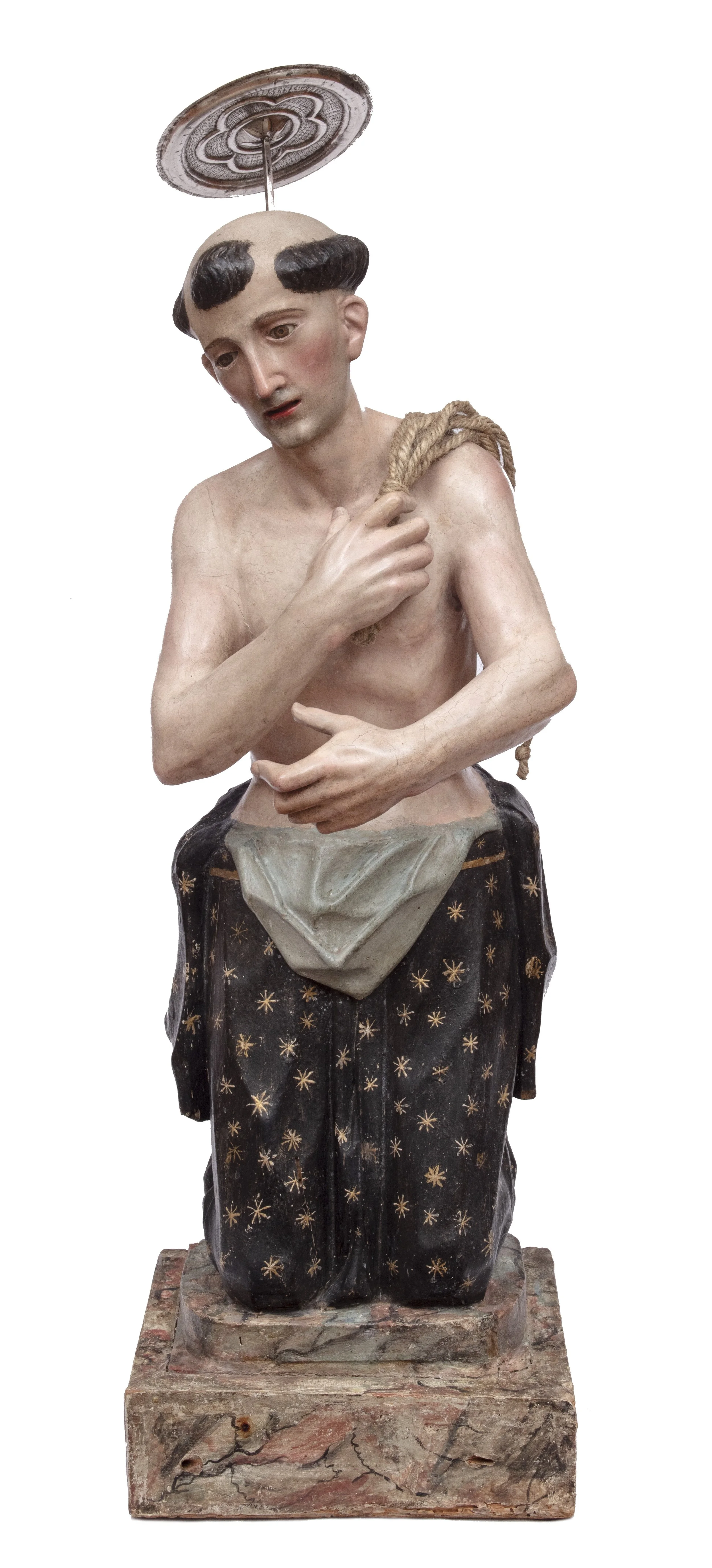
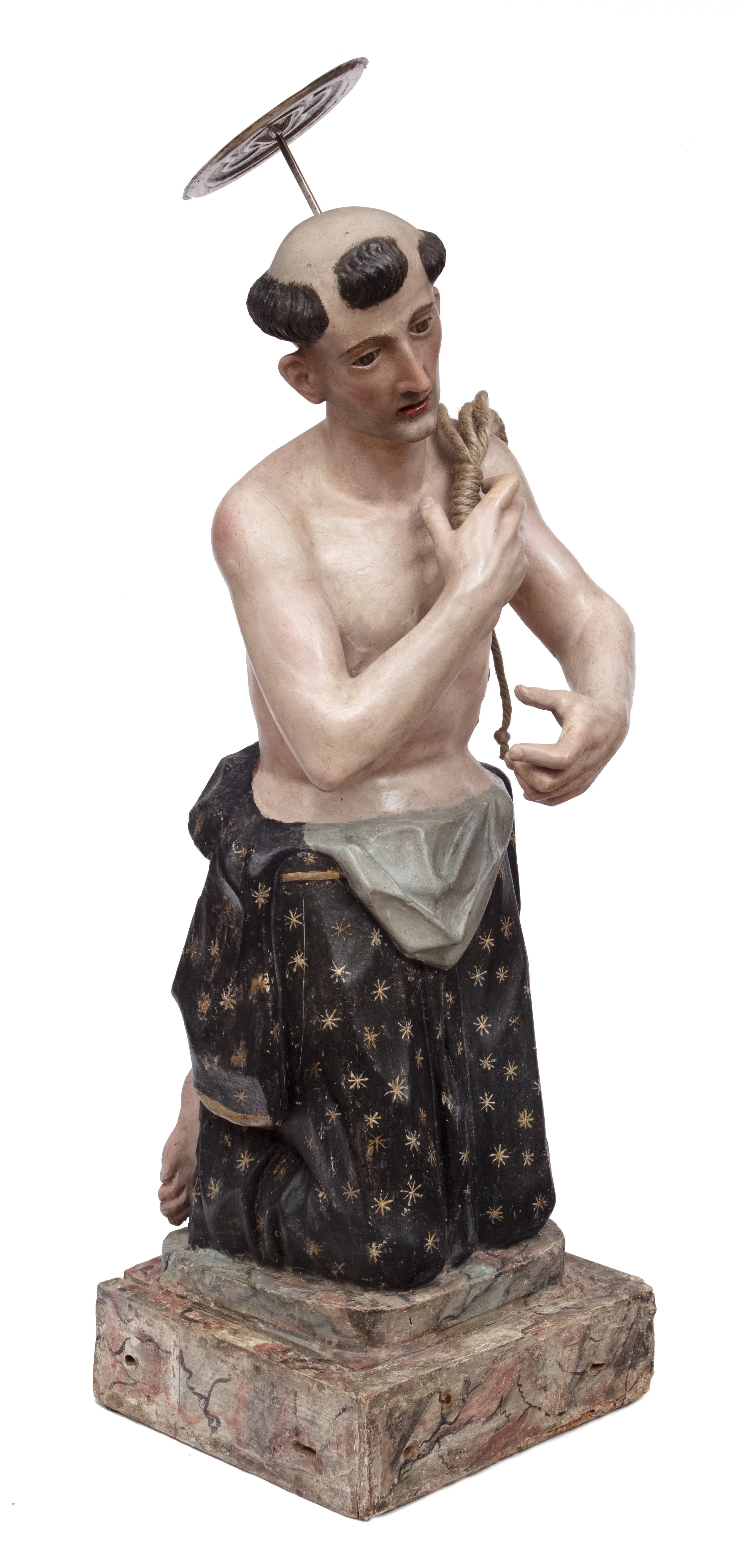
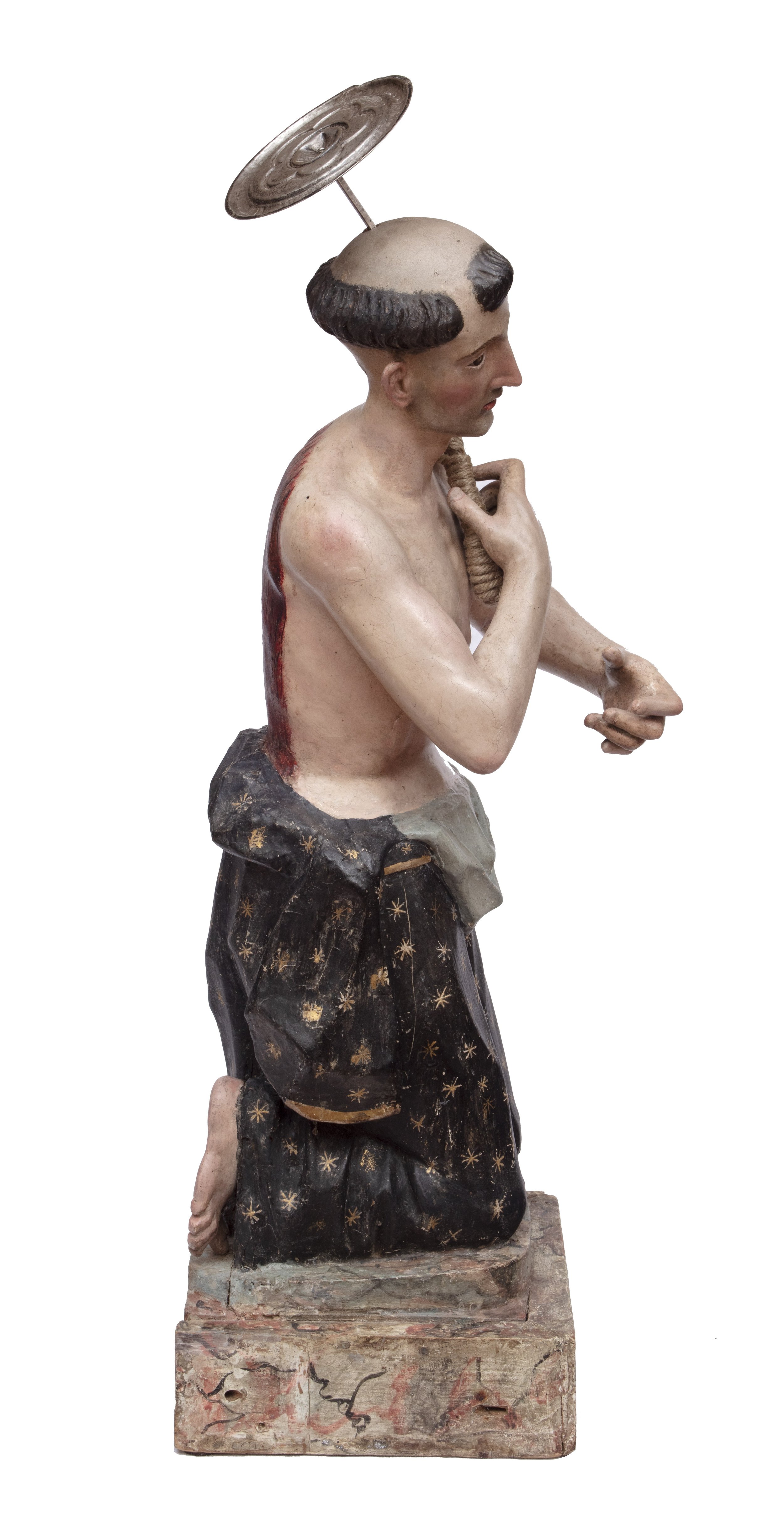
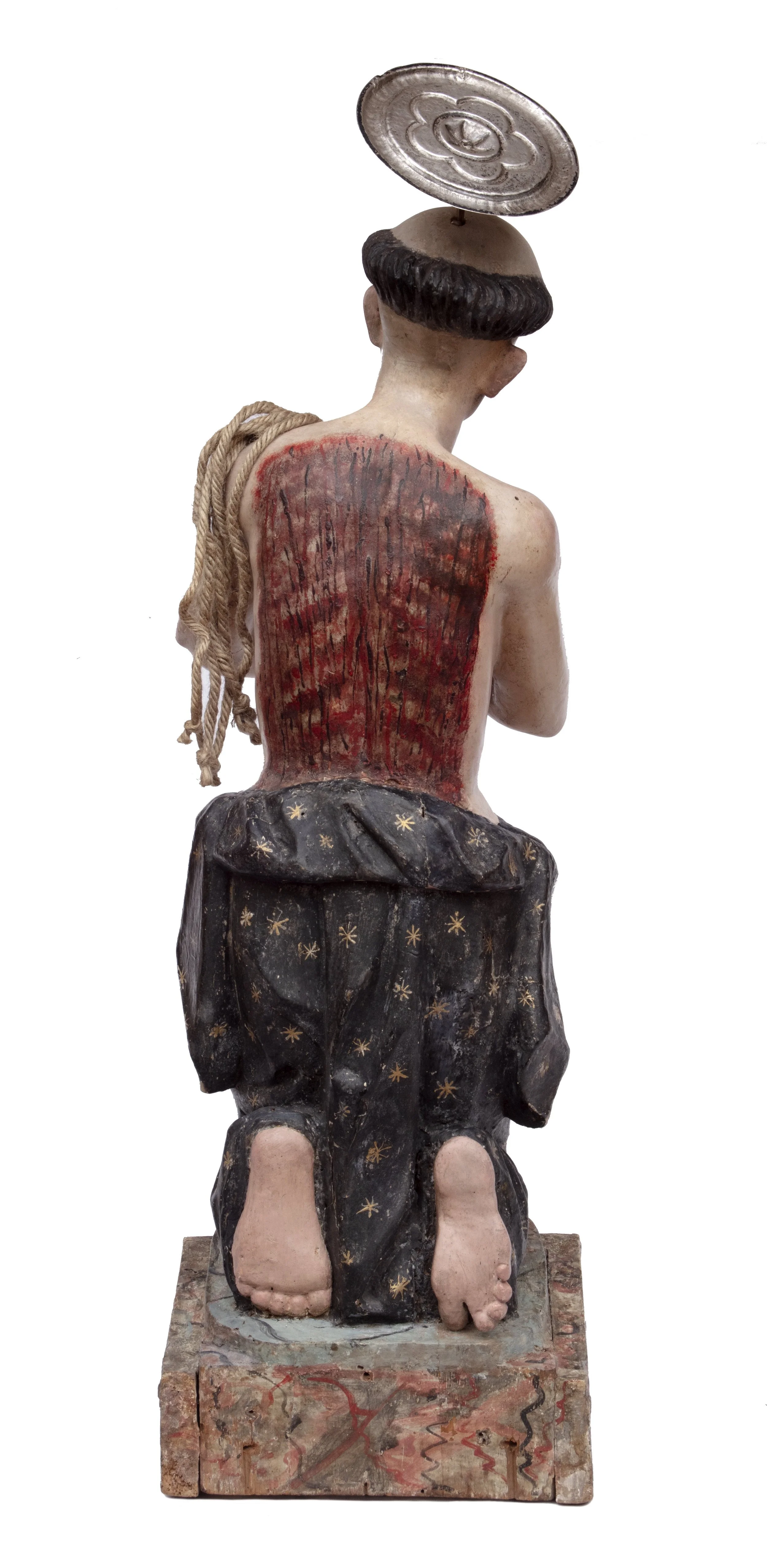
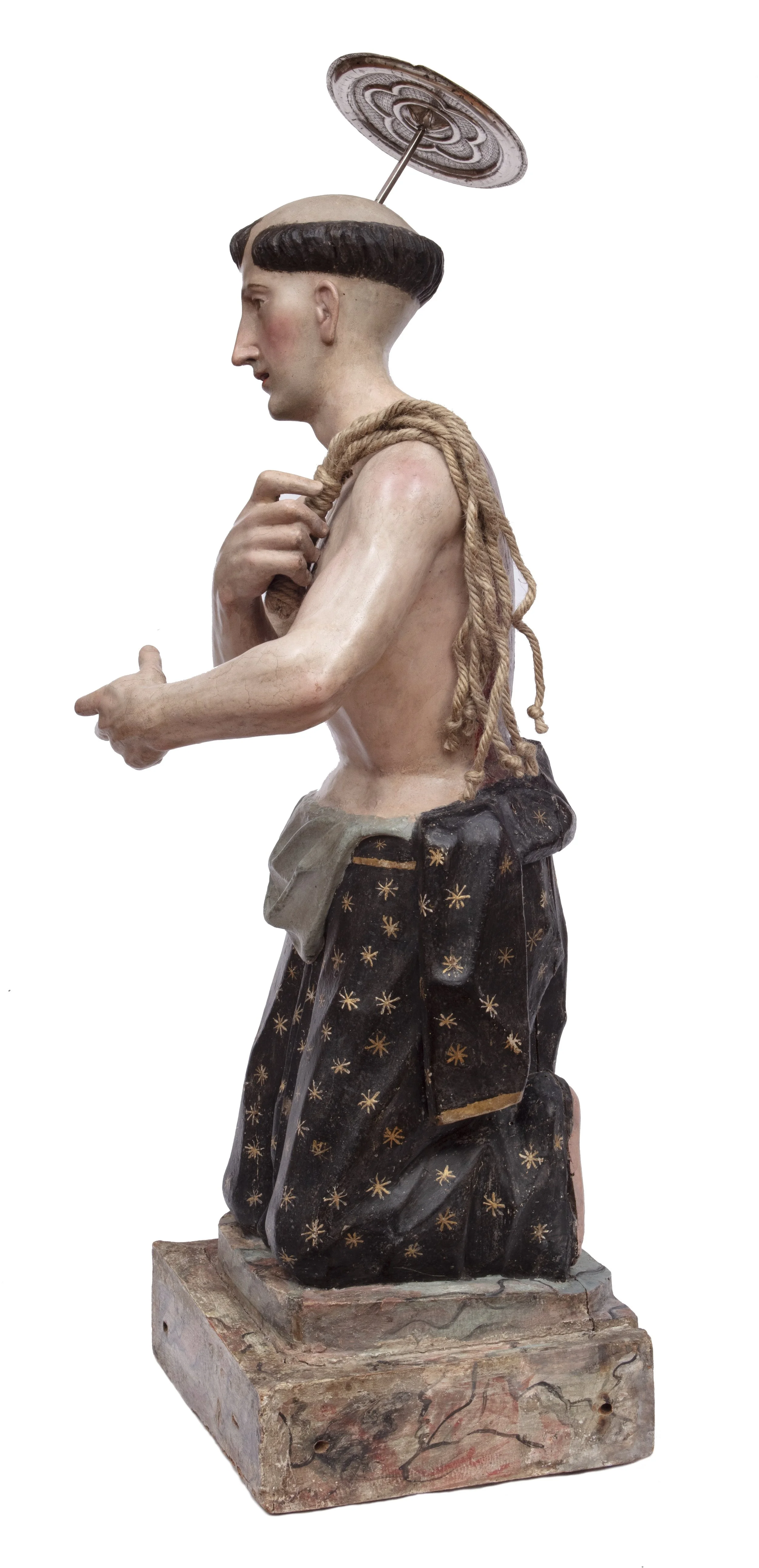
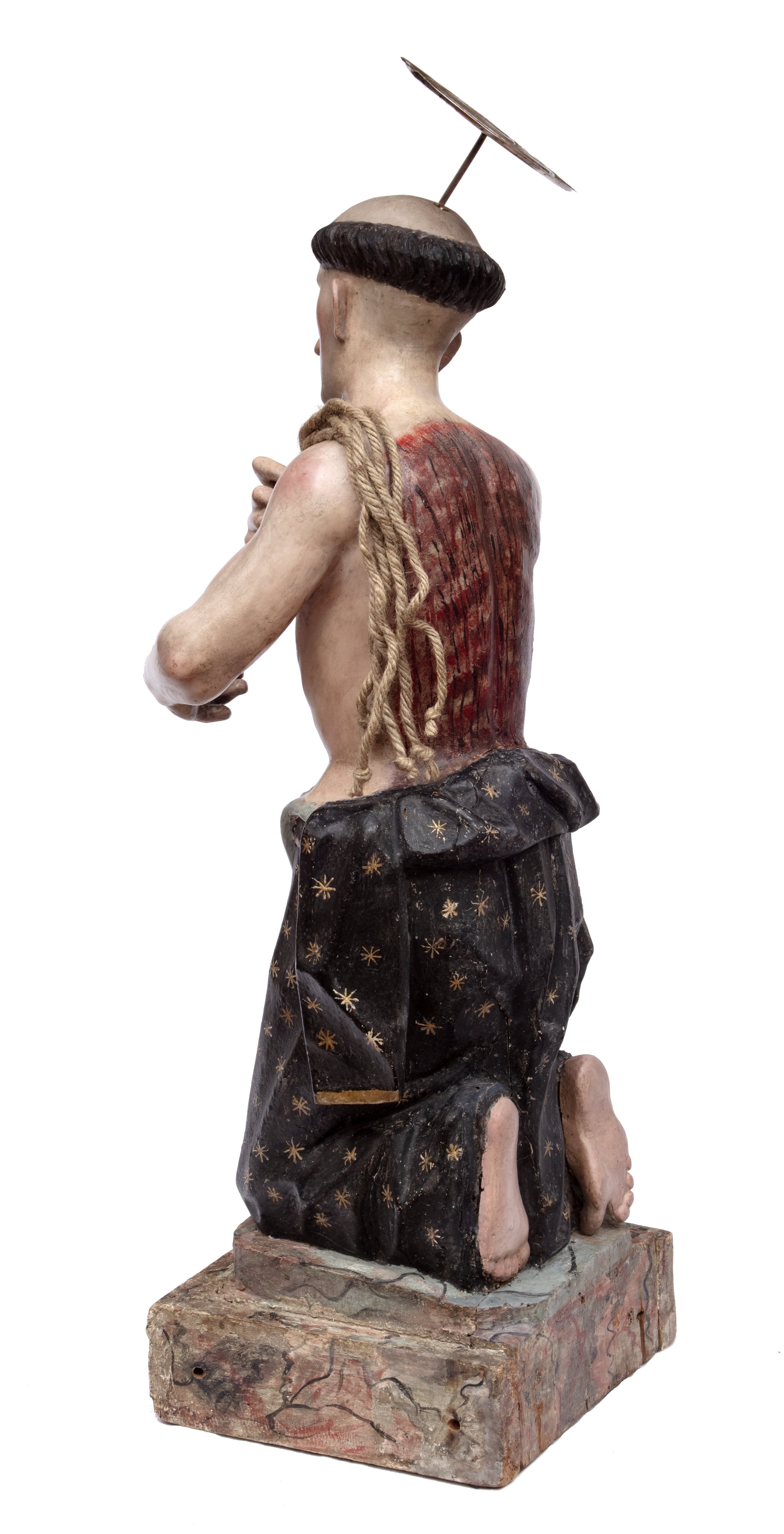
This startling sculpture presents a distinctly Mexican depiction of Saint Nicholas of Tolentino. Nicholas of Tolentino (1245–1305) was an Augustinian monk and the first canonized saint of his order. His cult was widely promoted by the Augustinians across the following centuries in Europe and in the Americas, where depictions of him frequently focused on the penitential act of self-flagellation. Here Nicholas is shown kneeling with his habit lowered and tied around his waist. In his left hand he may have once held a cross, and in his right he holds a whip for scourging himself. Seen from reverse, his wounds are rendered in grisly detail, as dark lines of blood trail down his reddened back. The sculpture may have originally been intended for private devotion, or alternatively for use during Holy Week processions or other processions of flagellants. During these, sculptures of saints showing self-mortification were paraded through the streets while Augustinian monks or members of lay brotherhoods would whip themselves in emulation of the holy figures. Hyper-realistic polychrome sculptures of this type are typical of Mexican art of the period and can be seen as a continuation and amplification of Spanish antecedents, where realism and drama were sometimes taken to extremes. While this sculpture was meant to inspire religious devotion, its visceral impact today elicits broader, but no less powerful responses.
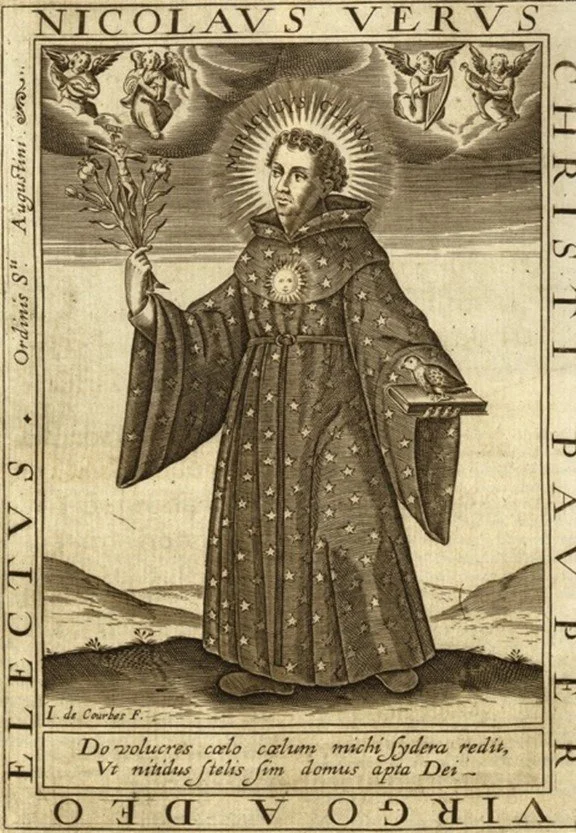
Fig. 1. Juan de Courbes, San Nicolás de Tolentino, Biblioteca Nacional de España, Madrid.
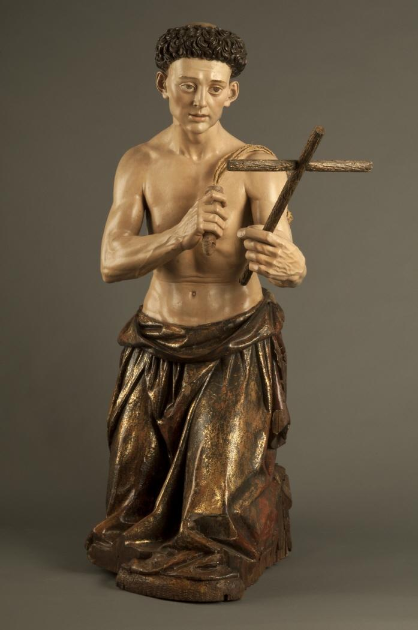
Fig. 2. Juan de Mesa, Saint Nicholas of Tolentino, Museo Nacional de Escultura, Valladolid.
Devotion to Saint Nicholas of Tolentino in the Americas stemmed from the popularity of his cult in Spain, where the saint was favored for his role as an intercessor for the souls in Purgatory, as a miracle worker, and as a healer through the loaves of bread he miraculously received from the Virgin Mary. The belief that the saint had intervened during the plague epidemic that struck Córdoba in 1601 led to a growing devotion to him throughout the 17th century, with numerous treatises and even a play by Lope de Vega were devoted to him. The most common iconography for the saint depicts him standing in a habit adorned with stars, holding a crucifix as well as a partridge on a book or tray—a scene popularized by the 1628 engraving by Juan de Courbes (Fig. 1). Depictions of the saint kneeling as a self-flagellant also derive from Spanish models, such as the impressive sculpture by the Sevillian sculptor Juan de Mesa (Fig. 2), but they were more common and took on a more severe form in the Viceroyalty of New Spain. In these works his role as intercessor for the salvation of souls in Purgatory is emphasized by his continuous mortifications and fasts, made evident by his gaunt, beardless face. In Mexico, Saint Nicholas found an especially devout following concentrated in mining areas (Guanajuato, Zacatecas, Taxco, or San Luis Potosí), where, thanks to the impetus of the Augustinians, penitential brotherhoods arose by the name of the Admirable Penitencia de San Nicolás de Tolentino.
We are grateful to Dr. Patrick Lenaghan, curator of the Hispanic Society, for his assistance in cataloguing this work. Dr. Lenaghan has suggested that the sculpture dates from the second half of the 18th century in Mexico. He has also noted that the reappearance of this sculpture in the Midwest is no surprise, as in the late 19th century, luxury tour operators frequently ran trains between this part of the United States and Mexico.