
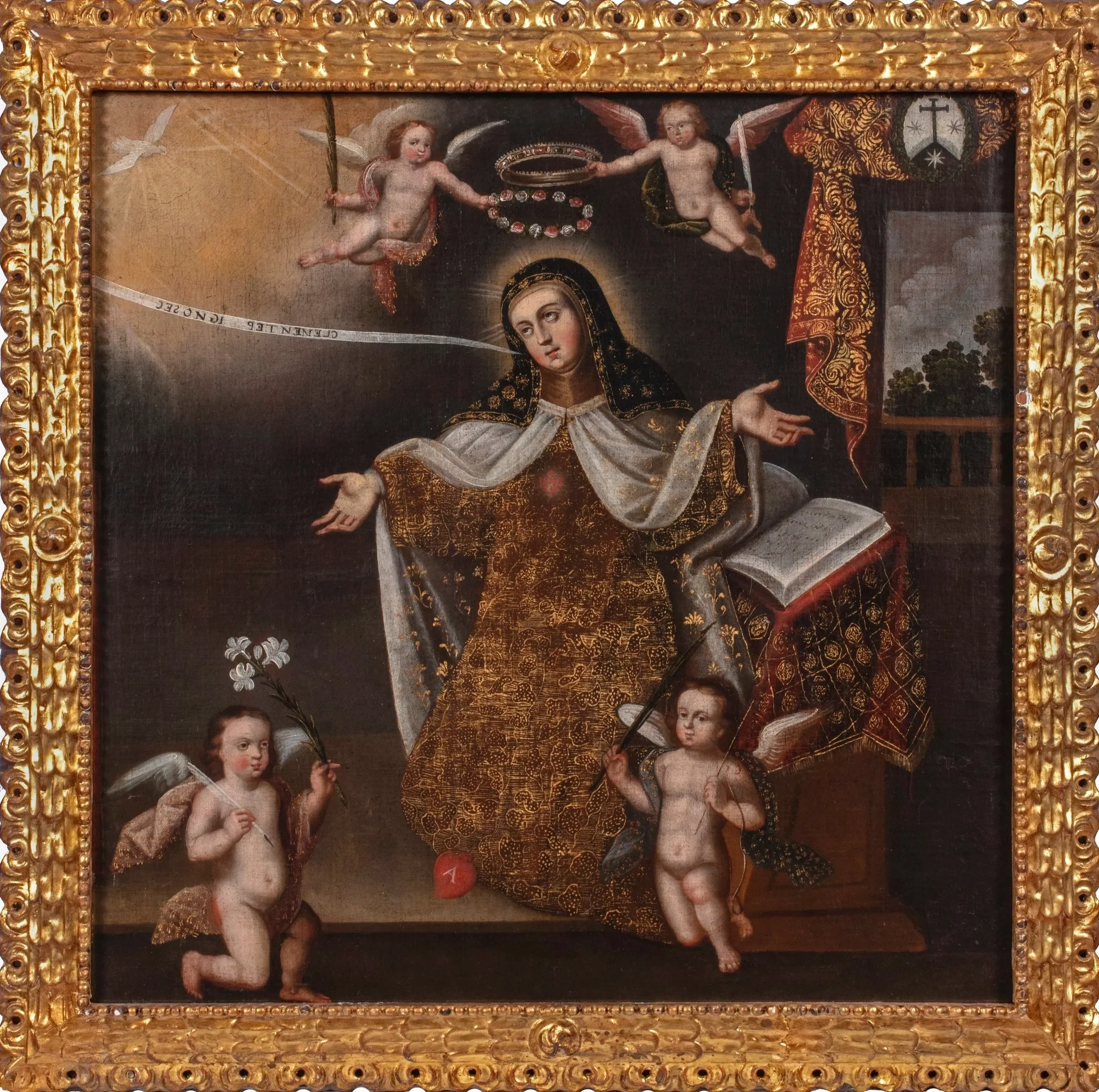
PERUVIAN, CUZCO SCHOOL, 18th Century
Saint Teresa of Ávila
Oil on canvas
32 ⅝ x 33 inches (82.9 x 83.8 cm)
Provenance:
Private Collection, Asunción, Paraguay, for at least the last 80 years.
This visionary depiction of Saint Teresa of Ávila is a superb example of the art of the Cuzco School. Like so many paintings of the period, the present work is a stylized and decorative treatment of the subject, one consonant with the ornamental preferences of the arts in the city, yet with a legibility permitting the communication of its religious content to the viewer.
Teresa of Ávila was a Spanish nun and mystic who reformed the Carmelite Order and founded the Discalced Carmelites. Beatified in 1614 and canonized in 1622, Saint Teresa became highly influential in Spain and the Americas. She is most commonly depicted pierced by an arrow at the moment of her miraculous transverberation, but here this is symbolized by the putto at her feet holding a bow and arrow, as well as the heart inscribed with an “A” (presumably for Ávila, her birthplace). Instead, the present composition centers on the Saint Teresa as the Holy Spirit descends on her in the form of a dove from the upper left. This corresponds to a vision described in Teresa’s autobiography, in which she recounts that the Holy Spirit appeared to her on the eve of Pentecost in 1569. Saint Teresa wrote numerous poems, often set to melodies, and she is here shown singing as a banderole carries her words (of uncertain meaning and origin) across the canvas: “CLENENT EP IGNOSEC,” written in reverse. She kneels at a prie-dieu with her arms outstretched, turning away from an open hymn book. This iconography was less common in the Americas—only one other Peruvian painting of the same scene, inspired by an engraving by the French painter Charles Le Brun, is known (Fig. 1).
In the present painting, Saint Teresa wears a beautifully patterned and highly decorated nun’s habit, trimmed with mordant gilding. A Christogram, IHS, appears in the center of her chest, possibly indicating her close relationship with the Jesuit Order. Three additional putti accompany her—one in the lower left holds a lily and a quill (attributes associated with Saint Teresa’s authorship of important mystical and reformist writings), while the two flying above are poised to place a crown of flowers and a crown of jewels on her head. The coat of arms of the Discalced Carmelite Order appears in the upper right above a decorative curtain, which, like the balustrade composed of turned wood poles below, is distinctly Spanish American in style and form. The subject of Saint Teresa of Ávila is relatively rare in Viceregal painting, making this work particularly special.
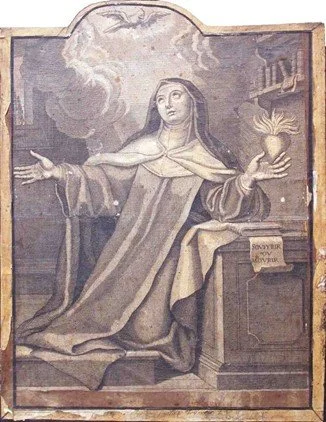
Fig. 1. Peruvian, 18th Century, Saint Teresa of Ávila, after an engraving by Charles Le Brun, Convento de Santa Teresa, Arequipa, Perú.