
MARIA LUIGIA RAGGI
(Genoa, 1742 – 1813)
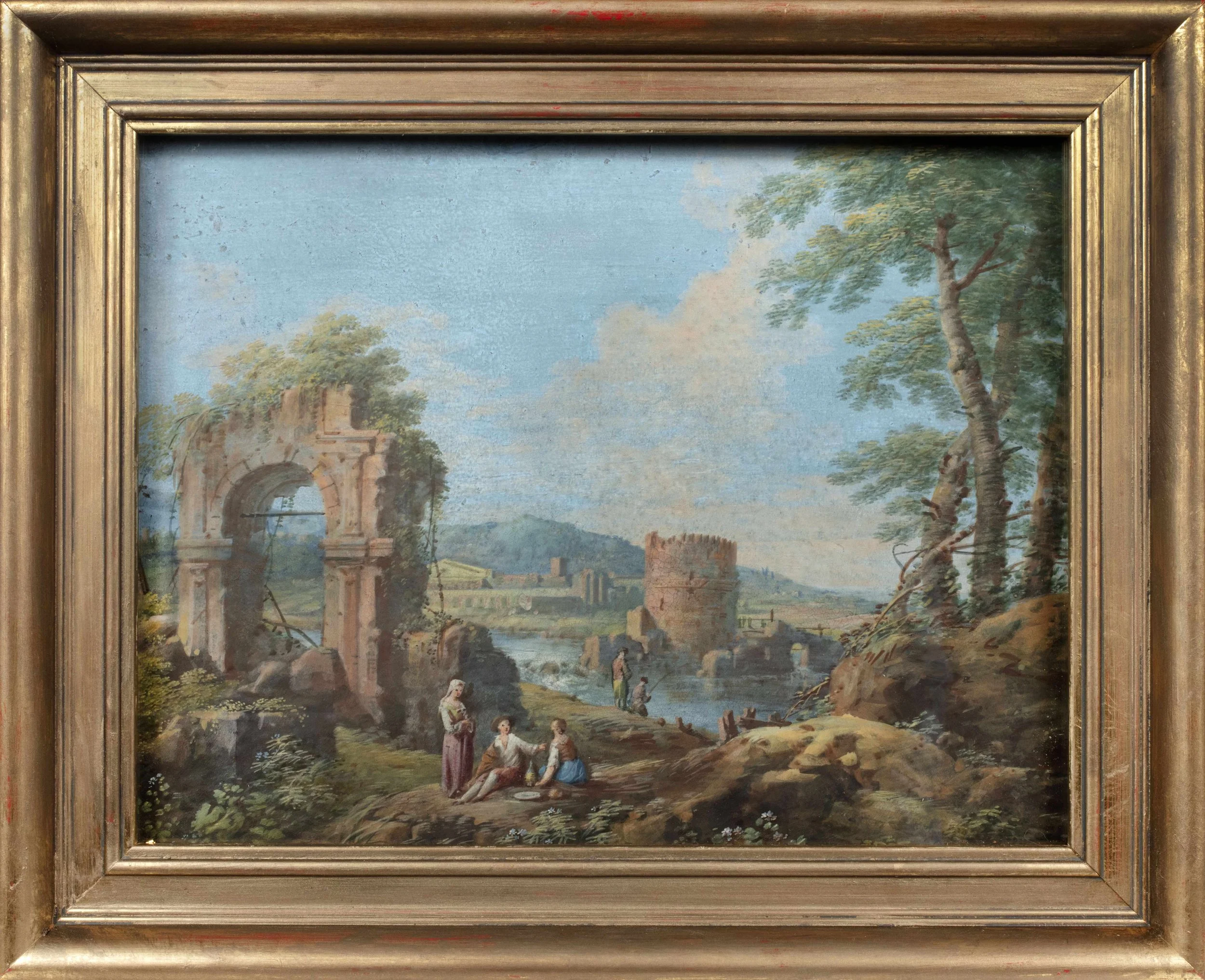
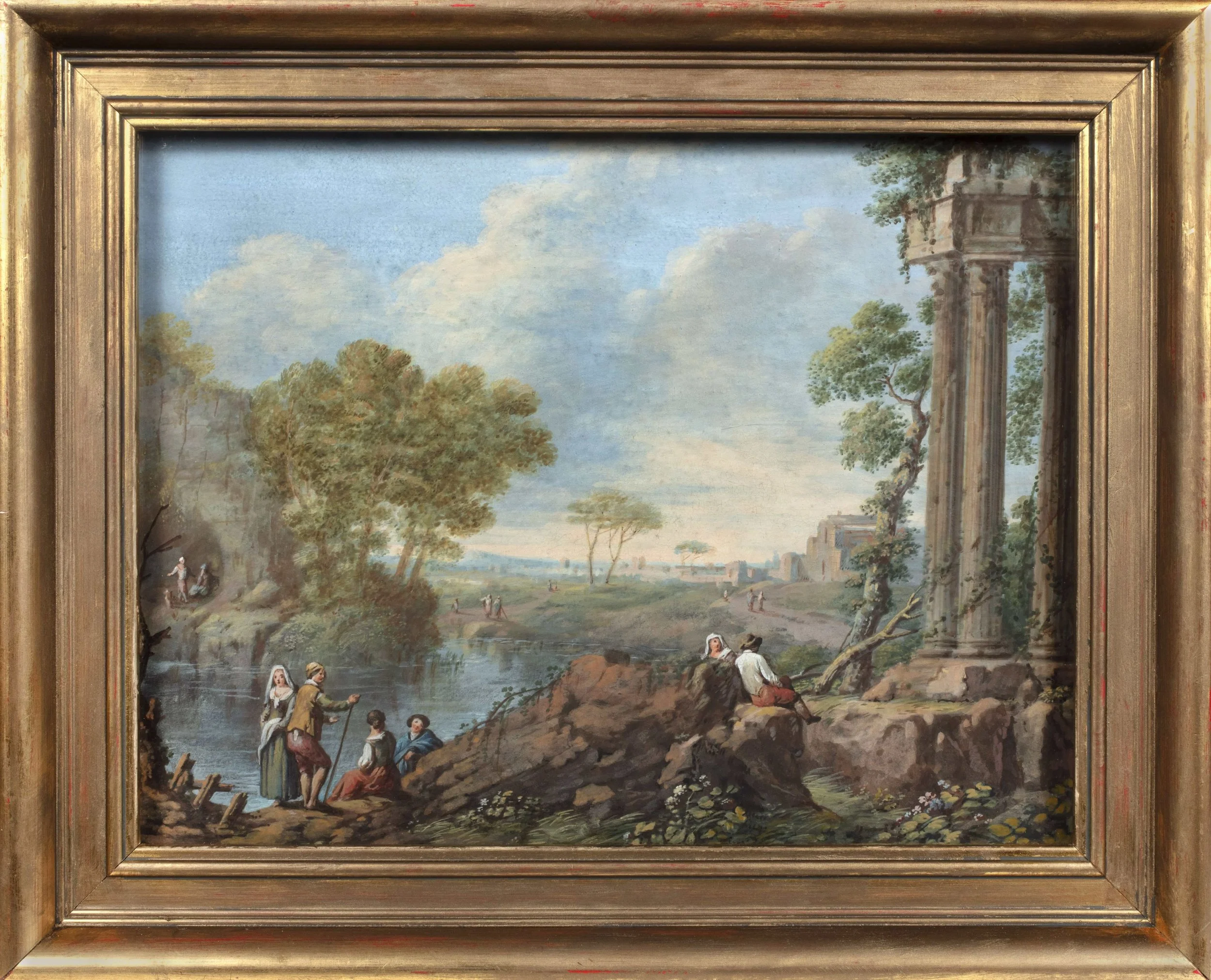
A Pair of Capricci: River Landscapes with Ruins
Tempera and gouache on paper
9 ¾ x 12 ⅝ inches (24.8 x 32.1 cm)
Provenance:
Zacarías González Velázquez, Madrid, by 1834; by descent in the artist’s family until 2024.
Literature:
Bertha Núñez, Zacarías González Velázquez (1763–1834), Madrid, 2000, cat. nos. P-177 and P-178, pp. 227, 354, illustrated, incorrectly attributed to Zacarías González Velázquez.
Maria Luigia Raggi is one of the most elusive and fascinating landscape artists of 18th century Italy. While her body of work was first assembled on the basis of style, Raggi’s artistic personality began to the take shape with the emergence of works monogrammed “M.l.r.” and her identity was only finally rediscovered in 2003 after three works signed with her full name came to light. Born Battina Ignazia Raggi to a family of noble Genoese and Roman lineage, she entered a cloistered order of Turchine nuns in Genoa at the age of eighteen, taking the name Suor Maria Luisa Domenica Vittoria. Given the strict rule of the order, it is likely that Raggi never left the confines of her convent for the remainder of her long life. This is especially remarkable considering the idyllic vision and nostalgic evocation of an Arcadian existence expressed through the roughly 80 surviving works by her. Almost all of small-to-medium format and executed in series or pairs in tempera and gauche, Raggi’s capricci are invented scenes which emerged completely from the mind of the artist. Her paintings—populated by everyday people and punctuated by imagined (and sometimes well-known) ancient ruins—represent what must have been a beautiful escape from an otherwise sheltered life.
In addition to those known in private collections, Raggi’s works include an extensive series in the Museo Civico di Prato, as well as pairs and smaller groups in the Pinacoteca Capitolina in Rome, the Accademia Nazionale di San Luca in Rome, and the Nelson Atkins Museum in Kansas City. The importance of Rome to her art, not only for its ancient monuments and sites but also for its storied local tradition of landscape painting, has led to scholars to hypothesize that Raggi spent a short period in the Eternal City, likely in the 1780s. This is difficult to account for, given that the cloistered life imposed on her at a young age did not allow for any exceptions, aside from extraordinary circumstances. Documentation of a certain “Battina Genovese” in Rome in 1781, precisely in the area in which her close relatives resided, might account for her stylistic development and her detailed knowledge of ancient Roman architecture.[i] Intriguingly, an oral legend that persists to this day at the Monastery of the Incarnation in Genoa recounts that two nuns escaped the cloistered convent at the end of the 18th century.[ii] We can only speculate that Maria Luigia Raggi might have been among them.
Our newly-discovered works on paper are characteristic examples of Raggi’s art. Populated with ancient ruins and contadini, these idealized depictions of the Roman countryside each prominently feature a river that flows through the middle of the scene—a typical compositional device of the artist. The figures in both works engage in a variety of activities, including fishing, resting by the riverbanks, or enjoying a mid-day meal with a fiasco of wine. In one of the scenes, across the river a couple is seen in an open cavern, while others travel along roads into the distance.
Maria Luigia Raggi’s authorship of the present works has been confirmed by Dr. Consuelo Lollobrigida (written communication). These works on paper were rediscovered in Madrid, where they had long been kept by the descendants of the Spanish painter Zacarías González Velázquez (1763–1834). They were previously published as by González Velázquez in a monograph of the artist, but that attribution is not tenable. This pair was previously part of a set of four landscapes that were recorded in the possession of the artist at his death in 1834—the other two are lost.[iii] While Zacarías González Velázquez never travelled to Italy, it is possible that these works by Raggi could have been acquired by his brother Isidro González Velázquez (1764–1840) during his Roman sojourn between 1790–1795, and then gifted to Zacarías.
[i] Consuelo Lollobrigida, Maria Luigia Raggi: Il Capriccio Paesaggistico tra Arcadia e Grand Tour, Rome, 2012, pp. 82-83.
[ii] Lollobrigida, Maria Luigia Raggi, p. 70.
[iii] Inventario Bienes de 1834, “62 [a, b, c, d] Cuatro países en láminas de cobre, pintados al temple, de un pie y tres pulgs. de ancho, por once pulgs. de alto, con cristales y marcos moldados y dorados, en cuatrocientos y ochenta reales.” See: Bertha Núñez, Zacarías González Velázquez (1763–1834), Madrid, 2000, pp. 407, 416. Both of these works on paper were previously laid down on copper and marked on the reverse with the number 62, but have recently been removed from the copper backing in the process of conservation treatment. The works are later recorded in the 1866 inventory of the artist’s son, Gabino González Velázquez y Fernández: “[30/33] Cuatro paisajes pequeños pintados en cobre con marco, [en] 960 reales.” See: Núñez, Zacarías González Velázquez, p. 421.