
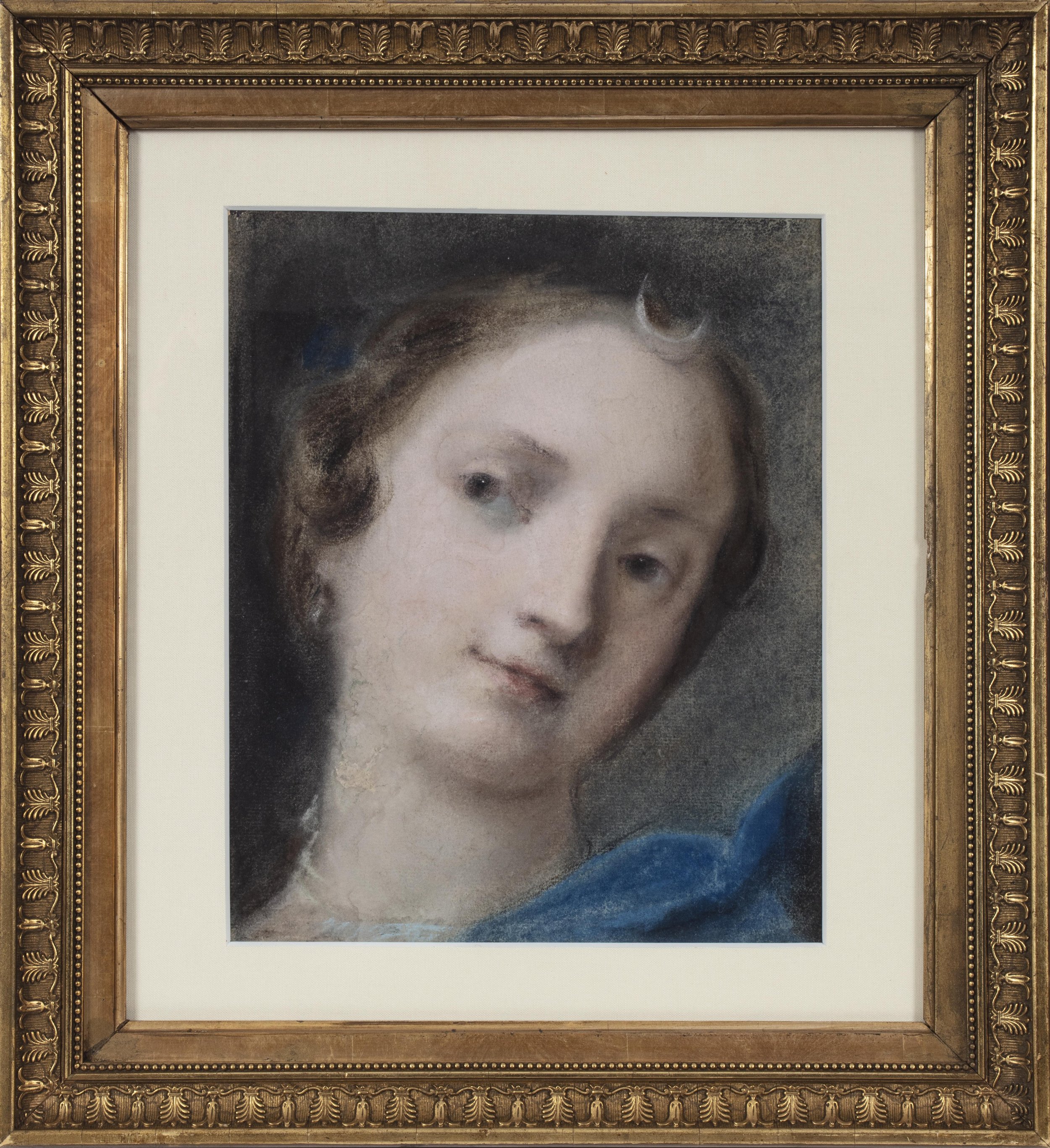
ROSALBA CARRIERA
(Venice, 1673 – 1757)
Diana
Pastel on blue paper
10 x 8 ¼ inches (25.4 x 21 cm)
Provenance:
Cardinal Giacomo Antonelli (1806–1876); by descent to
Count Augusto Antonelli, by 1971[1]; by descent to his wife:
Countess Alina Goldman Antonelli; by descent to her son:
Private Collection, New York, until 2025.
Rosalba Carriera was among the most celebrated artists in 18th-century Europe and a pioneer of the use of pastel. It was largely due to her exploration of the medium and her technical brilliance that pastels gained new popularity not only as a vehicle for portraiture, but also for allegorical and mythological paintings.[2] Early in her life Rosalba had been largely excluded from formal art education and from professional societies on account her gender, which created significant challenges in establishing her professional credentials. However, by the early 1700s her natural abilities and her innovative approach gained her celebrity status, from which time she found a ready market for her pastels across Europe.
The present work is a newly discovered pastel by Rosalba depicting the Roman goddess Diana. Diana is here shown not as the virgin huntress, but as goddess of the moon—identifiable by her traditional symbol, the half-moon, that appears above her forehead. The figure gently tilts her head to the right while glancing up and away from the viewer as if seen in mid-movement, her attention focused on something beyond the frame. Rosalba frequently depicted her allegorical and mythological figures with a sense of movement and lively expressions—a freedom that was not always permitted in her commissioned portraits. Rosalba and her patrons had a particular fondness for depictions of Diana, as it was a subject to which the artist frequently returned.[3] Notably, the Swiss artist Jean-Étienne Liotard—one of the greatest pastellists of all time—owned a Diana by Rosalba, which he likely acquired directly from her during his visit to Venice in 1745.[4] Surviving letters and diary entries record Rosalba’s work on various depictions of Diana, especially in the 1730s.[5] Our work is distinguished by the figure’s soft smile, her sumptuous pearl earring, and the vibrant blue swaths of fabric in the lower right and tied at the back of her hair. Here the velvety effects of Rosalba’s pastel technique and the compelling realism helps us to see clearly what made her works so admired and desired in her lifetime, as well as ours.
We are grateful to Dr. Xavier Salomon for confirming Rosalba’s authorship of this Head of Diana based on firsthand inspection. The present work will be included in his forthcoming catalogue raisonné on the artist. Salomon has suggested that the size and format of the work is likely original, especially as the upper part of the paper retains its deckle edge. He has also noted that the presence of nail holes at the corners reflect the artist’s practice of gluing paper to canvas and then nailing it to the stretcher.
[1] Count Augusto Antonelli was the direct descendant of Cardinal Giacomo Antonelli, the Secretary of State to Pope Pius IX. The Cardinal had a significant collection of artworks, and these were passed on to his relatives after his death. Augusto inherited the remnants of the Cardinal’s estate that his parents had received, including the present work. The pastel is recorded in an appraisal of Augusto’s collection in Rome by M. & C. Sestieri dated 18 June 1971.
[2] For further information on Carriera’s contribution to the development of pastel as a medium, see: Thea Burns, The Invention of Pastel Painting, London, 2007, pp. 101-130.
[3] See Rosalba’s many treatments of the subject as recorded by Neil Jeffares in his Dictionary of Pastellists: http://www.pastellists.com/Articles/Carriera2a.pdf, pp. 8-12.
[4] http://www.pastellists.com/articles/carriera.pdf, p. 4.
[5] Angela Oberer, Rosalba Carriera, London, 2023, p. 111.