
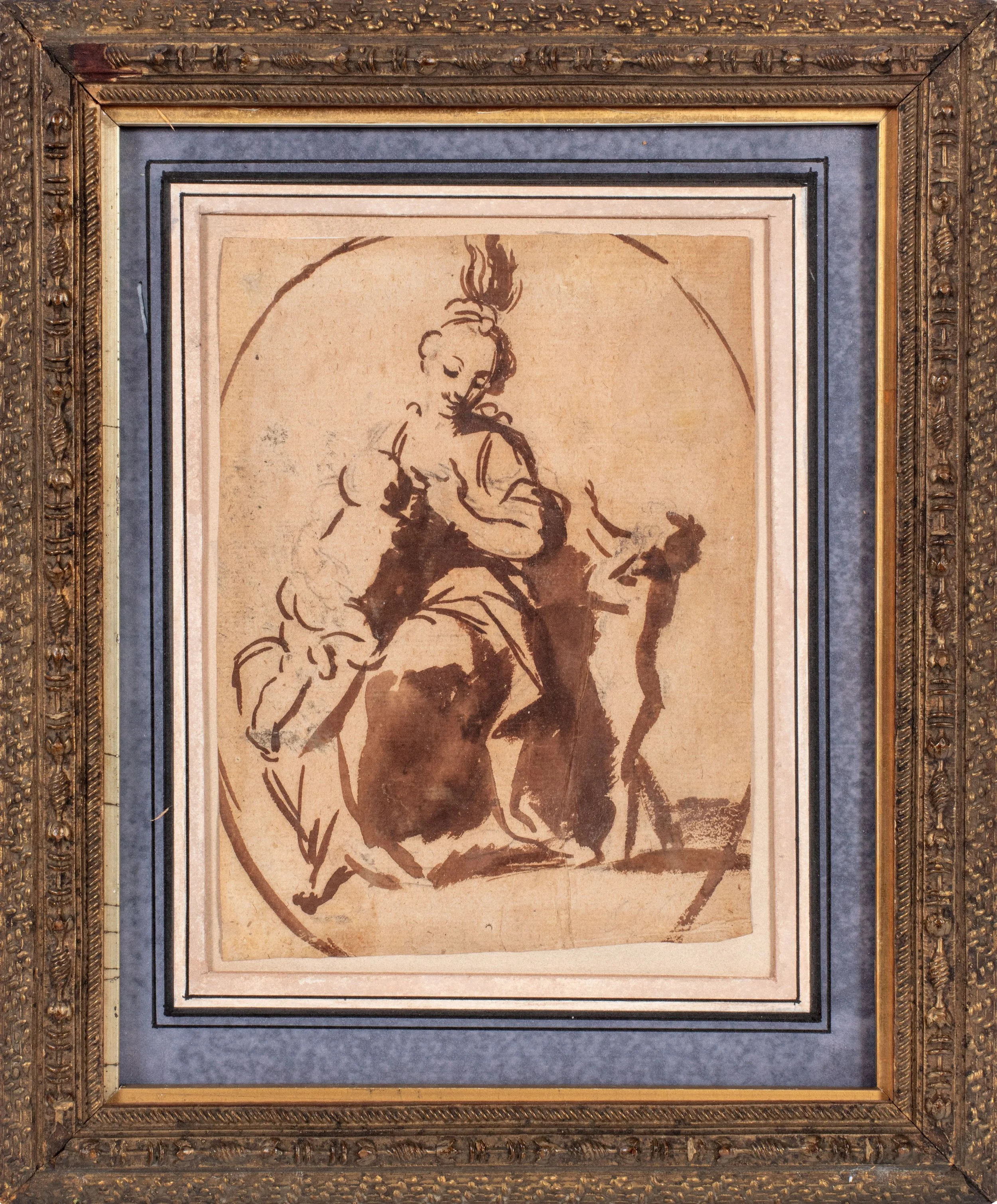
ELISABETTA SIRANI
(Bologna, 1638 – 1665)
Charity
Brush and ink over black chalk on paper
7 x 5 ¼ inches (17.8 x 13.3 cm)
Provenance:
Private Collection, USA, until 2025.
Famously described by Carlo Malvasia as “the glory of the female sex, the gem of Italy, the sun of Europe,” Elisabetta Sirani enjoyed great renown across Europe for her prolific talent and reputed beauty. Daughter of Giovanni Andrea Sirani (1610–1670), Guido Reni’s principal assistant, she had begun painting by the age of 17, most likely training under her father, since as a woman she would not have had access to an academy. Sirani worked principally for private aristocratic and ecclesiastic patrons, producing small-scale devotional works, larger religious and historical pictures, as well as altarpieces for major churches in and around her native city of Bologna. Upon her early death in 1665, aged just 27, she was immortalized in a series of poetic eulogies in which she was variously described as a “miracolo del Mondo” (“miracle of the world”), a female Apelles, even a Phoenix, the mythical bird who was continually reborn.[i]
As distinguished as Sirani was as a painter, she was equally celebrated as an engraver and a draughtswoman. Her graphic oeuvre is the largest of any female artist in early modern Italy, and her drawings are rendered with a highly individual style and technique. Sirani rapidly executed her drawings, which lends an especially painterly verve to her compositions.
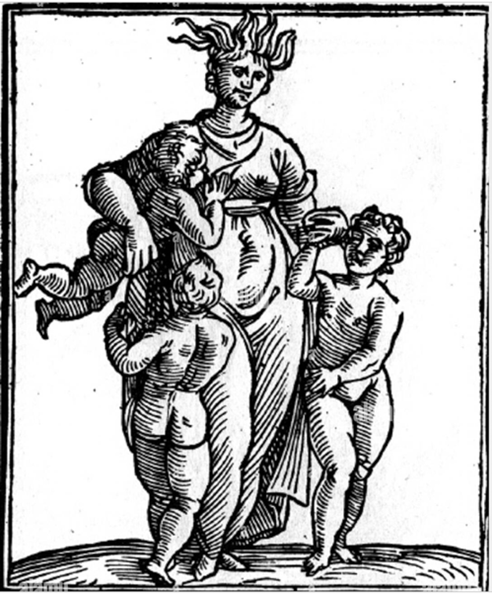
Fig. 1. Charity from Carlo Cesare Ripa’s Iconologia (1603).
The subject of the present drawing, a seated woman breastfeeding a child with another child standing nearby, is a study for an allegorical depiction of Charity. The principal figure can be identified as Charity both by the flame above her head and the presence of the two children that accompany her. The subject follows the iconographical scheme laid out by Carlo Cesare Ripa, who wrote that Charity is traditionally shown surrounded by children for whom she cares. As shown in the engraving in Ripa’s Iconologia of 1603, Charity has a flame above her and holds a boy in her arms while nursing him, with other children playing at her feet (Fig. 1).
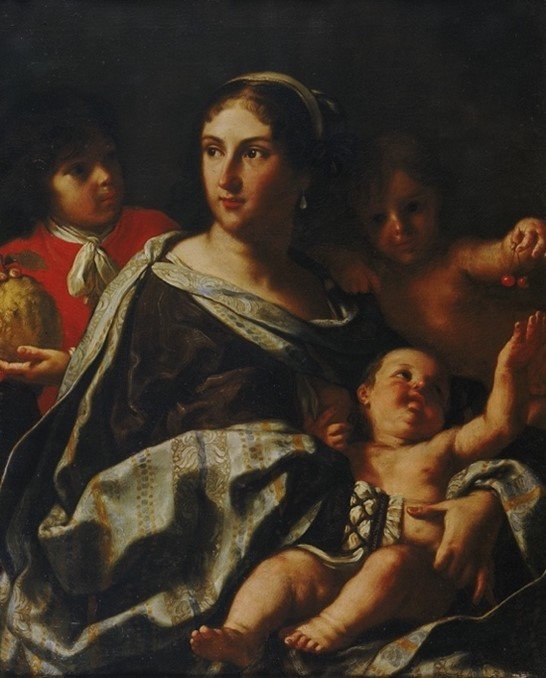
Fig. 2. Elisabetta Sirani, Portrait of Anna Maria Ranuzzi as Charity, Cassa di Risparmio, Bologna.
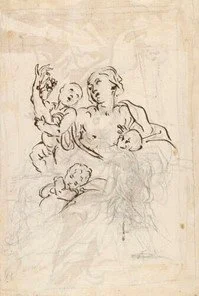
Fig. 3. Elisabetta Sirani, Study for Charity, Royal Collection, Windsor.[iii]
Sirani painted the subject of Charity on several occasions at the very end of her career. In 1664 she painted a half-length Charity caring for three children (untraced), as well as her Allegory of Justice, Charity, and Prudence in Vignola.[ii] In 1665, the final year of her life, she painted two versions of her Portrait of Anna Maria Ranuzzi as Charity in 1665 (Fig. 1). A related preparatory sketch for Charity is in the Royal Collection (Fig. 2), and both drawings remain close in type to Ripa’s iconography. These may be primi pensieri—first thoughts for the painted compositions—or independent exercises. Our drawing is especially noteworthy as it beautifully showcases not only Sirani’s technical bravura of drawing in ink with a brush, but also her sensitive treatment of subjects that centered on women. The freedom and animation of the drawing finds close comparables throughout Sirani’s oeuvre.
Elisabetta Sirani’s authorship of this drawing has been confirmed by Dr. Babette Bohn on the basis of firsthand inspection.
[i] The half-length Charity is recorded in her list of works: “Una Carità mezza figura del naturale che con la destra mano appoggiandosi il dito alla bocca fa cenno ad un bambino che taccia, l’altro che si mostra addormentato nel prendere il latte, sostiene sul braccio sinistro, il terzo vestito di azurra vesticciola, mostra un pomo a' riguardanti, per l'Ill.mo sig. Cesare Marsigli.”
[ii] “La poesia muta celebrata dalla pittura loquace. Applausi di nobili ingegni al pennello immortale della Sra. Elisabetta Sirani pittrice bolognese,” 1666. See: Babette Bohn, “Il Fenomeno della Firma: Elisabetta Sirani,” in Elisabetta Sirani. “Pittrice Eroina” 1638–1665, exh. cat., Museo Civico Archeologico, Bologna, 2004-2005, pp. 113-114.
[iii] http://rct.uk/collection/search#/1/collection/903679/charity.