
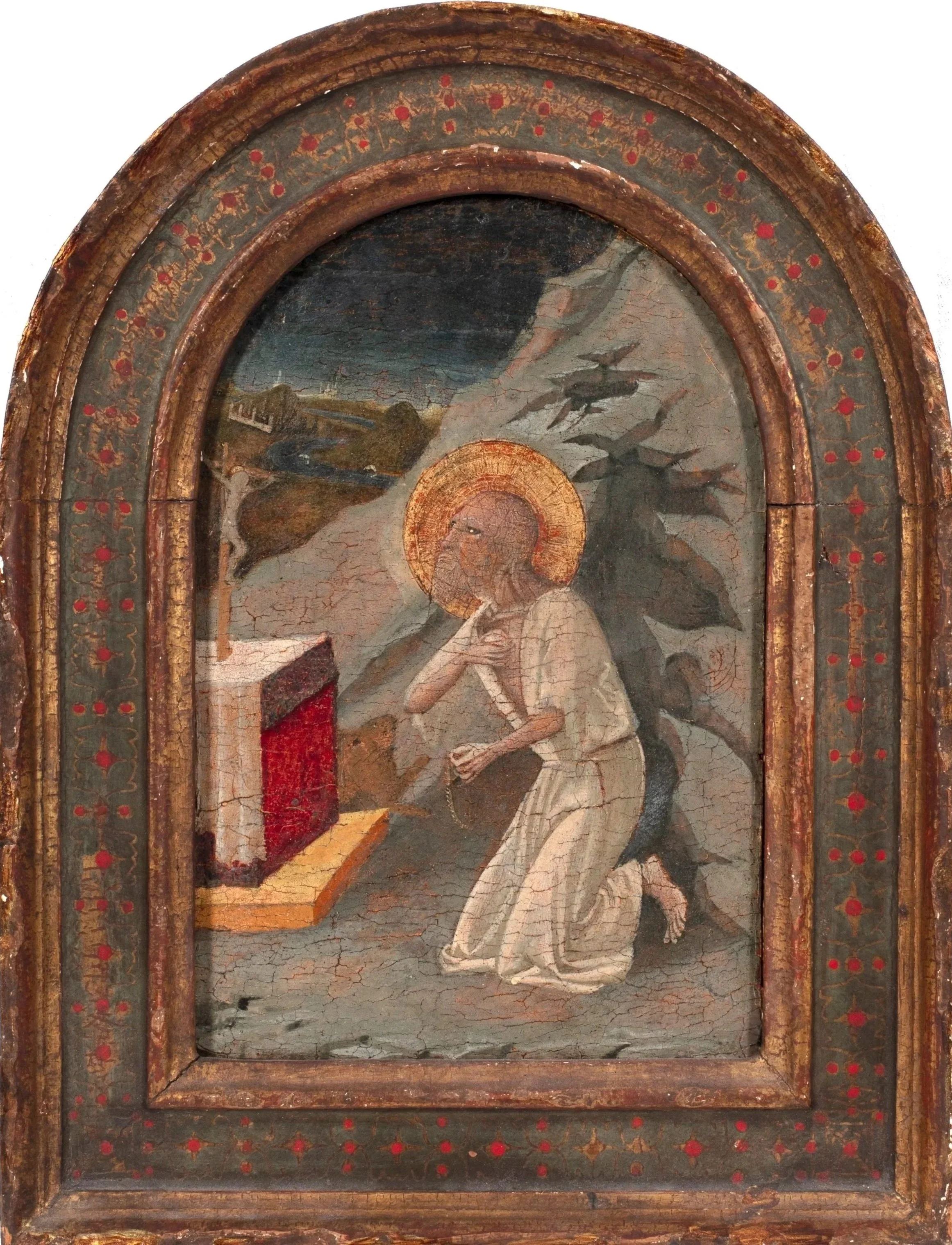
PAOLO UCCELLO
(Florence, ca. 1397 – 1475)
Saint Jerome in the Wilderness
Tempera on panel, curved top
11 ⅜ x 8 ¼ inches (29 x 21 cm) panel
9 ⅜ x 6 ⅛ inches (24 x 15.5 cm) painted surface
Provenance:
Wilhelm Suida, New York, acquired in Florence ca. 1905–1959; by descent to:
Suida-Manning Collection, New York, 1959–1996
Private Collection, USA, 1996–2019
With Robert Simon Fine Art, 2019; from whom acquired by:
Private Collection, Pennsylvania, 2019–2026.
Paolo Uccello was one of the giants of the Italian Renaissance, celebrated most of all for his frescoes and his three grand paintings comprising The Battle of San Romano (Florence, Uffizi; Paris, Musée du Louvre; and London, National Gallery). Independent paintings by him are of the greatest rarity, numbering only twenty-four; of these only two are privately owned.[1] Thus the present painting, though damaged over time, is a precious discovery and an important addition to the artist’s oeuvre. It is presented here with minimal restoration to preserve its integrity and purity of form.
Uccello was both a witness to and a protagonist in one of the most pivotal moments in the history of Italian painting: the birth of the Renaissance. Much more than a transitional figure, he was a masterful artist who seamlessly blended the lyricism of late medieval painting with the stylistic developments of the early Florentine Renaissance. After initially training in Lorenzo Ghiberti’s workshop in the second decade of the 15th century, he quickly became an original interpreter of the perspectival innovations of his fellow artists Masaccio, Filippo Brunelleschi, Donatello, and Leon Battista Alberti.
Our Saint Jerome in the Wilderness is an unpublished work by Uccello, long in the private collection of the art historian Wilhelm Suida and his family.[2] The penitent saint is depicted kneeling before an altar adorned with a red antependium, white altar cloth, and a sculpted crucifix. With his back to the opening of a cave, Jerome is shown in the act of beating his chest with a stone. He appears in three-quarter profile staring intently at the image of the crucified Christ and holding a set of prayer beads in his left hand as he contemplates Christ’s death. At the base of the altar, a lion, one of Jerome’s attributes, raises its paw in the air and looks up at the saint. Opposite the cave that serves as the backdrop for the scene in the foreground, the upper left of the composition opens onto a view of a mountainous landscape, slightly skewed in its idiosyncratic depiction of the curvature of the earth. Small boats sail along a winding river, while fortified towns are perched on and around the green hilltops.
Despite the paucity of Uccello’s paintings, there are numerous analogies to our Saint Jerome in other works by the artist. Uccello included similar depictions of the saint as a hermit in his fresco in the Chapel of the Assumption in the Prato cathedral,[3] as well as in The Way to Perfection (Galleria dell’Accademia, Florence; Fig. 1)[4] and the Adoration of the Child (Staatliche Kunsthalle, Karlsruhe; Fig. 2).[5] The tight folds of the white robe, the saint’s emaciated body, and his elongated toes have direct parallels in these works; the position of Jerome’s pointed feet (with his big toe supporting his weight on the ground) and his overall pose (with his pelvis angled back and his torso bent forward) correspond exactly to both his counterpart in the Karlsruhe panel and to the figure of Saint Francis in the Madonna and Child in the Allentown Art Museum (Fig. 3).[6] Additionally, in each of these three works, the saint’s robes similarly adhere to the figure’s thighs, emphasizing the shape of his legs and the gap between them.
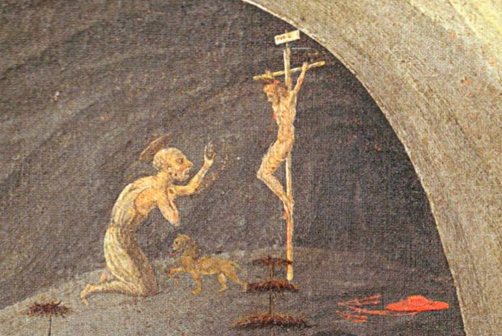
Fig. 1. Paolo Uccello, Detail of The Way to Perfection, Florence, Galleria dell’Accademia.
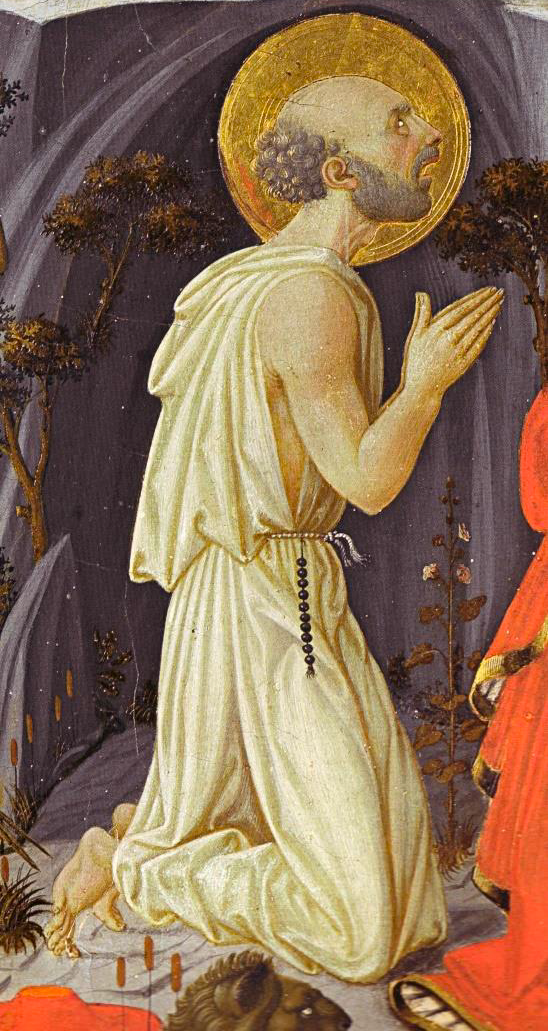
Fig. 2. Paolo Uccello, Detail of the Adoration of the Child with Saints Jerome, Mary Magdalene, and Eustace, Karlsruhe, Staatliche Kunsthalle.
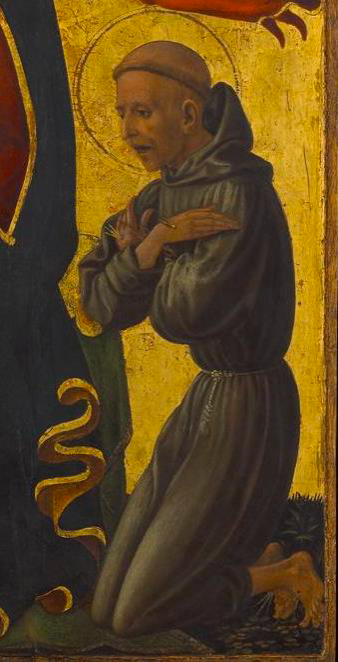
Fig. 3. Paolo Uccello, Detail of the Madonna and Child with Saint Francis and Two Angels, Allentown, Allentown Art Museum.
The articulation of the cave and the distant landscape are clearly related to early works of the artist. The craggy opening of the cavern, which is depicted in a pale gray color that becomes darker in the shaded areas, is comparable to that found in both the Saint George and the Dragon in the National Gallery of Victoria in Melbourne and the Annunciation in the Ashmolean in Oxford (Fig. 4).[7] They are especially similar in the way that rock is fractured into sharp, pointed teeth, anticipating the mouth of the cave in Uccello’s later Saint George and the Dragon in the National Gallery, London (Fig. 5).[8] The Oxford Annunciation also provides a direct counterpart to our Saint Jerome in terms of the rolling landscape, populated with similarly rendered fortified villages in grey and white (Figs. 4 and 6). Just visible on the river that cuts across the landscape are two unfurled sails, their arched shape corresponding to that in Uccello’s Adoration of the Child in Karlsruhe (Fig. 7).
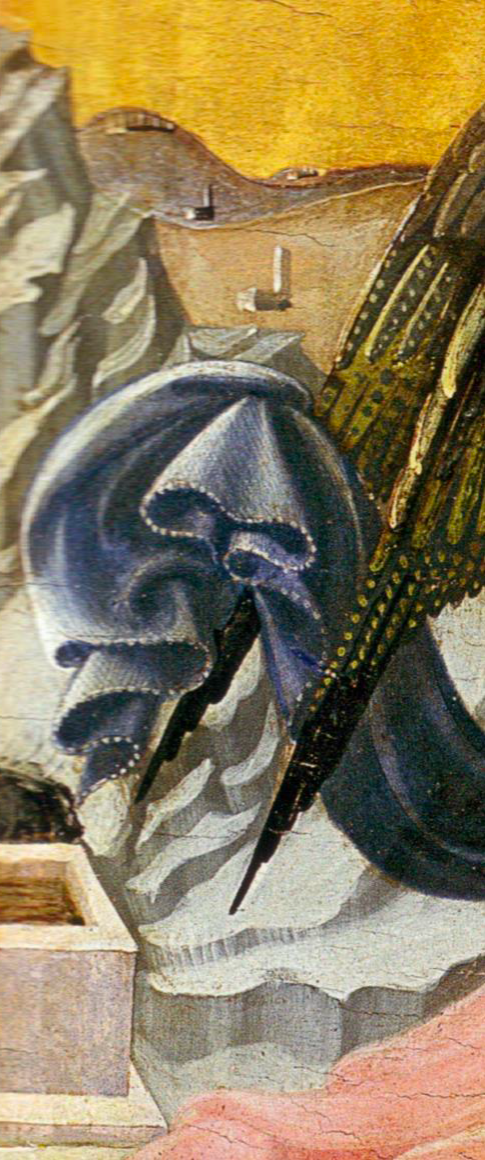
Fig. 4. Paolo Uccello, Detail of the Annunciation, Oxford, Ashmolean Museum.
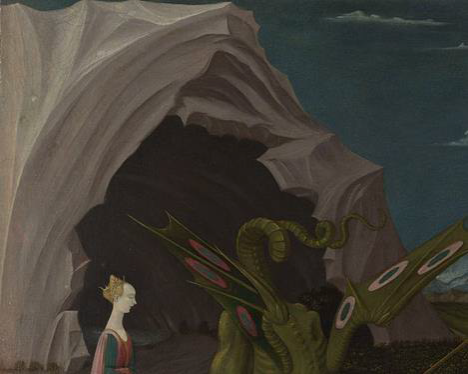
Fig. 5. Paolo Uccello, Detail of the Saint George and the Dragon, London, National Gallery.
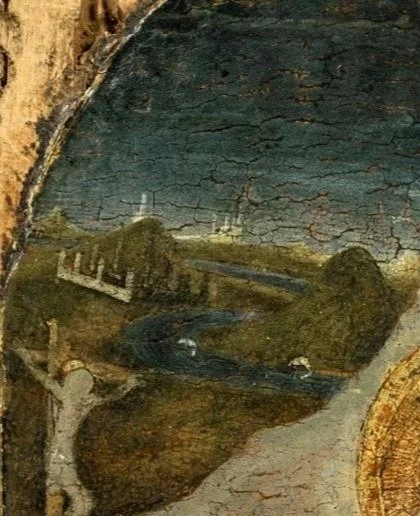
Fig. 6. Detail of the present painting.
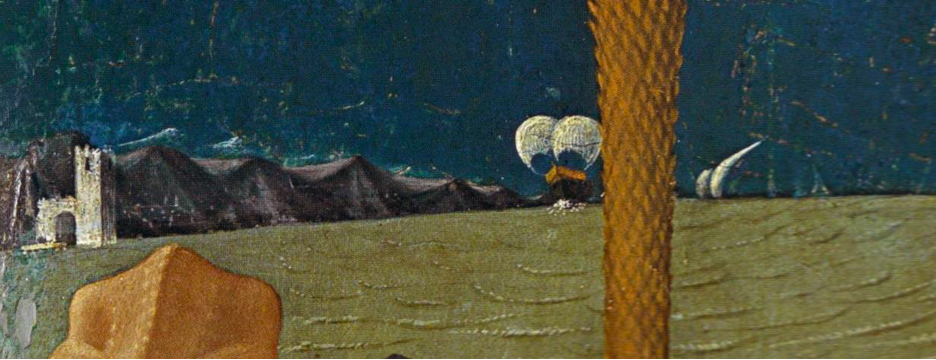
Fig. 7. Paolo Uccello, Detail of the Adoration of the Child with Saints Jerome, Mary Magdalene, and Eustace, Karlsruhe, Staatliche Kunsthalle.
With its naturalistic approach to the sky—rendered in a deep blue that becomes lighter in color as it approaches the horizon—this painting proclaims its maturity compared to the Saint George in Melbourne and the Annunciation in Oxford, in which the sky is simulated by the gold ground. While our painting does not begin to exhibit the sophisticated perspectival projections of Uccello’s later works, such as in the landscape of his later Adoration of the Child in Bologna,[9] the beginnings of his perspectival experimentation is here already suggested in the imperfectly receding lines of the altar and the base beneath, which do not converge to the same vanishing point. Nevertheless, Uccello’s ability to communicate depth is apparent in the course of the river, which wraps around and behind the verdant hills.
The present panel survives in its original dimensions, although there is clear evidence of an engaged molding and applied decoration, now lost. The original barbe survives, as do adjacent incisions in the panel that determined its placement and that of the framework. A series of small cavities along the sides of the panel suggest that Solomonic colonnettes once formed part of the decoration. Traces of a repetitive pattern along the top curve of the paint may reflect a floating frame with a scalloped motif. The panel, which retains its original thickness, preserves what appears to be its original decorative finish of red bole with blackened silver at its sides. The verso is covered with a brownish black paint layer of indeterminate age.
Our Saint Jerome was first associated with the early work of Paolo Uccello by Keith Christiansen and its authorship was recently confirmed after cleaning by Mauro Minardi, to whom we are grateful for his observations. Dr. Minardi’s forthcoming article on the painting is available upon request. He has written of the Saint Jerome:
“Beyond the iconographic affinities to the works of Paolo Uccello, the attribution to Uccello is confirmed by the relationship of several elements—including the figure of the saint, the treatment of the landscape, and the spatial characteristics of the scene overall—to the earliest works of the Florentine master. Also in favor of the attribution to Uccello is the color palette, which combines the pale white and grey with the brilliant shades of red and yellow: a combination of these last two colors is visible in the children depicted in the foreground of the Presentation of the Virgin at the Temple in the fresco cycle in the Prato cathedral. The landscapes in the background of this fresco and in two treatments of the Adoration of the Child in Karlsruhe and Bologna display slightly more mature conceptions in terms of their perspectival construction. This clearly indicates that the present painting is datable to an earlier moment in the artist’s career around the year 1430, subsequent to his Saint George and the Dragon in Melbourne and the Annunciation in Oxford. It was around this time that Uccello returned to Florence after a documented sojourn in Venice.[10] Despite the damage suffered in some areas of the paint, this work is a precious exemplar of Uccello’s art that displays all the characteristics of the autograph paintings of his early activity. It is impregnated with a lingering nostalgia for earlier Gothic style, but beyond this, elements such as the sky that brightens along the horizon signal that it was conceived at the dawn of the Renaissance. Above all, this work is a new testament to Uccello’s bizarre temperament and his ever lyrical and somewhat fable-like representations of the world.”
Our panel was no doubt intended as a private devotional work to serve as a model of penitential life for its owner. The penitent Saint Jerome was an especially popular subject in the first half of the fifteenth century, influenced by the recent founding of the Order of the Hermits of Saint Jerome in Fiesole by the Blessed Carlo dei Conti Guidi da Montegranelli. The Order was officially recognized in the early 1400s and a lay confraternity was established in Florence shortly thereafter. The Compagnia di Santa Maria della Pietà, known as the Buca di San Girolamo, counted many members from the Florentine patriciate, and small-scale images of Jerome kneeling before a crucifix in the wilderness were particularly favored by affiliates of the Confraternity.[11]
Mauro Minardi has noted that Paolo Uccello enrolled in the confraternity of the Buca di San Girolamo in 1438, and according to Vasari executed a fresco (now lost) in the institution’s meeting place: the Ospedale di San Matteo in Piazza San Marco.[12] Minardi has further suggested that Uccello may have been patronized by the Confraternity before joining its ranks,[13] and hypothesizes that the present work could have been commissioned by one of the Confraternity’s members.[14] He points out that the cave in the present painting could refer to the “buca,” or “hole” (referring to Jerome’s cavernous dwelling place in the wilderness), after which the institution was known. Additionally, Saint Jerome’s act of beating his chest with a stone may reflect the ascetic practices of the confraternity, which promoted self-flagellation by at least 1439. Alternatively, the fact that our Saint Jerome is dressed in a monastic habit that is open at the chest—a typology closely connected to the Hieronymite community (such as in the Saint Jerome by Fra Angelico in the Princeton University Art Museum)—may indicate that this work was painted for a member of the Order of the Hermits of Saint Jerome in Fiesole.
[1] See: Mauro Minardi, Paolo Uccello, Milan, 2017.
[2] The painting is likely identifiable with “il quadretto di S. Girolamo” cited in a letter to Suida in March 1940, recording paintings still remaining in his residence in Venice following his emigration to the United States in 1939. Cf. Jonathan Bober, in Capolavori della Suida-Manning Collection (Milan 2011), pp. 18, 22n12.
[3] For the frescoes in the Prato cathedral, see: Minardi, Paolo Uccello, pp. 79-111.
[4] Minardi, Paolo Uccello, pp. 297-304.
[5] https://www.kunsthalle-karlsruhe.de/kunstwerke/Paolo-Uccello/. Minardi, Paolo Uccello, pp. 118-125.
[6] http://collections.allentownartmuseum.org/detail.phpmodule=objects&type=browse&id=19&term=Uccello%2C+Paolo&page=1&kv=150
91&record=0&module=objects. For the Allentown painting, see: Minardi, Paolo Uccello, pp. 125-127.
[7] https://www.ngv.vic.gov.au/explore/collection/work/3747/; and http://collections.ashmolean.org/collection/search/per_page/25/
offset/0/sort_by/relevance/object/38216. For these works, datable to 1424-1425, see: Minardi, Paolo Uccello, pp. 42-48.
[8] https://www.nationalgallery.org.uk/paintings/paolo-uccello-saint-george-and-the-dragon. Minardi, Paolo Uccello, pp. 273-282.
[9] Minardi, Paolo Uccello, pp. 145-152.
[10] A letter from 1432 reveals that in 1425 Paolo Uccello executed a mosaic on the façade of the basilica of San Marco in Venice. In 1427 he was still outside Florence, but he must have returned by 1433 and possibly even before 1431. See: Hudson, Paolo Uccello, p. 16; Minardi, Paolo Uccello, pp. 55, 64-65.
[11] Carl Brandon Strehlke, in The Bernard and Mary Berenson collection of European paintings at I Tatti, Florence, 2015, p. 488; and Laura Alidori Battaglia, “An unpublished miniature from the circle of Fra Angelico,” The Burlington Magazine, vol. 151 (August 2019), pp. 520-521.
[12] Hugh Hudson, Paolo Uccello: Artist of the Florentine Renaissance Republic, Saarbrücken, 2008, pp. 19, 379. For more on this confraternity, see: Ludovica Sebregondi, Tre confraternite fiorentine. Santa Maria della Pietà, detta “Buca” di San Girolamo, San Filippo Benizi, San Francesco Poverino, Florence, 1991.
[13] Minardi, Paolo Uccello, p. 131, footnote 75.
[14] Minardi notes that there was a second Buca di San Girolamo, called “della Notte,” located at the monastery of San Giorgio all Costa, which may provide an alternative origin for the painting.