
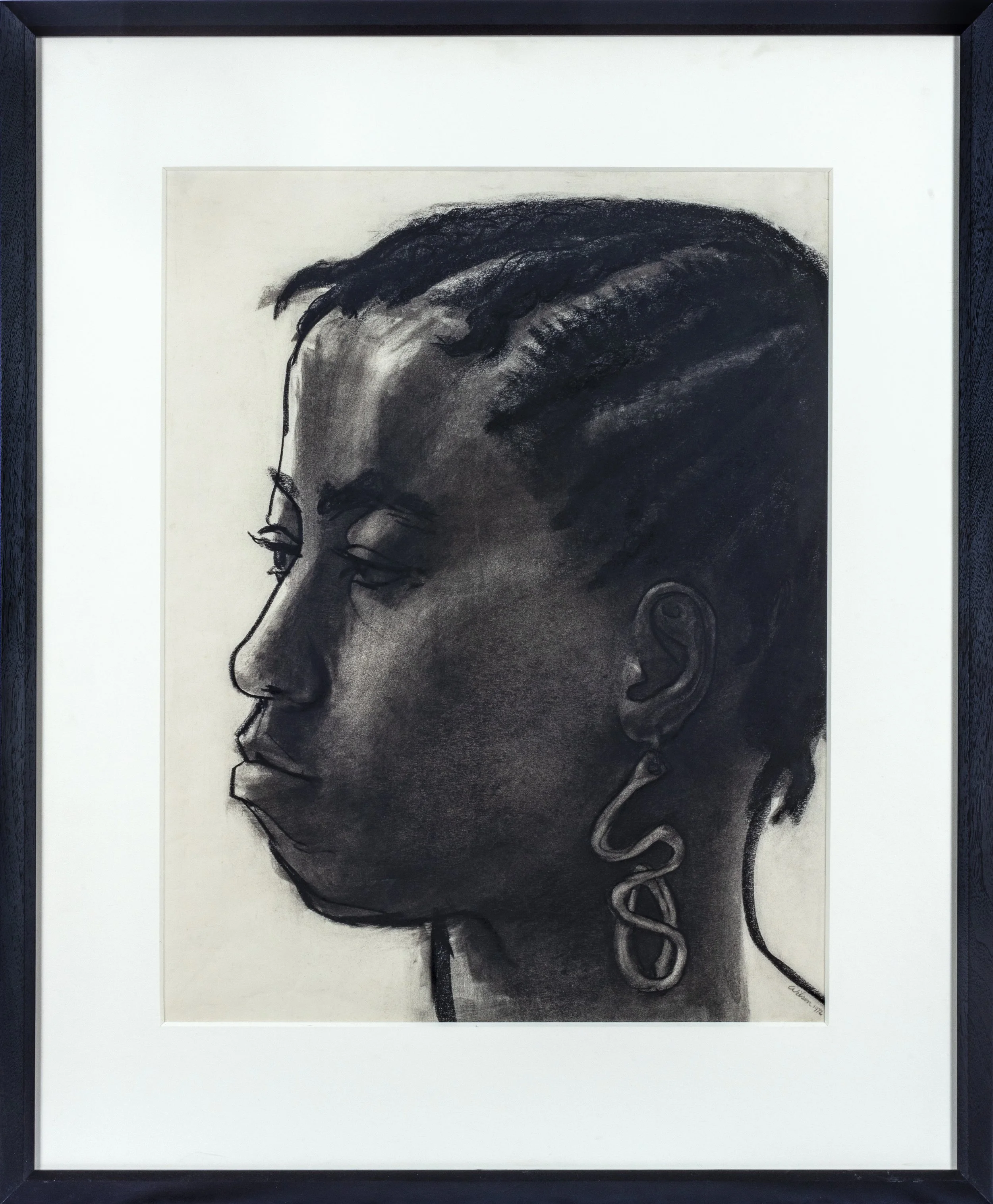
JOHN WILSON
(Roxbury, MA, 1922 – 2015)
Lezli
Signed and date, lower right: Wilson 1972
Charcoal and pastel on paper
24 x 19 inches (60.9 x 48.3 cm)
Provenance:
The artist’s estate.
The subject of a recent exhibition at the Metropolitan Museum of Art, John Wilson made vivid and powerful works that spoke to his life as a Black American artist. Wilson’s artistic achievements are profoundly intertwined with his commitment to racial and social justice. Working across a variety of media—painting, sculpture, printmaking, and drawing—his art centers and celebrates Black figures. His large format studies offer unique insight into his working process and reveal his exceptional abilities as a draughtsman. Wilson spent most of his career in Boston, with a significant chapter in New York in the 1950s and 60s. Throughout his career he focused on the authentic and emotionally resonant portrayals of Black people. In his work, he strived to portray a “universal humanity” that could be a point of identification for all.
The present drawing is one of John Wilson’s extraordinary large-format head studies. This closely-cropped image of a young girl dates from the same period in which the artist sought to create a large-scale bronze sculpture of a genderless human head inspired by various world traditions of sculpture—Mesoamerican, Rapa Nui, and Buddhist. Using charcoal and pastel, Wilson crisply outlines the face and explores its contours through the interplay of light and shadow, lending a striking dimensionality to the image. The sitter is Akua Lezli Hope, an award-winning poet and writer, and another long-time friend of Wilson’s daughter Becky. Her richly textured cornrows and sculptural earring are beautifully described by Wilson and captures elements of the model’s personal style within an artistic project that sought to capture universal themes. A related depiction of Lezli is in the collection of the Museum of Fine Arts, Boston.
Originally from Massachusetts, John Wilson’s innate artistic abilities were recognized and nurtured by his teachers at the Roxbury Boys’ Club. His formal artistic education began at the School of the Museum of Fine Arts, Boston and continued in Paris under Fernand Léger and in Mexico City at several institutions, where he studied the pioneering works of the Mexican muralists. These early experiences gave Wilson examples of ways to represent the injustices he observed at home in the United States. After his return, he continued to pursue printmaking as a medium for wide distribution of politically conscious art focused on addressing the violence facing Black Americans. His art also sought to envision a positive future for Black Americans that lived up to the democratic ideals of the country, in addition to representing such figures as “beautiful and true and precious.” During his six-decade career, he taught art at various institutions and exhibited his drawings, paintings and sculptures widely. Wilson is celebrated for his use of dark tones to create an intensely sculptural quality to his drawings and prints which the artist himself described as “carving out space—an illusion of space and a kind of sculptural form—so that I would use values to create a sense of weight and mass.”
Throughout his life, John Wilson created predominantly figurative work that centered on his friends, family, and community. His work derives its immediacy and poignancy from these connections. Wilson’s work was exhibited early in his career at the Metropolitan Museum of Art’s 1950 American Artists Under Thirty-Six. John Wilson is a recipient of many honors and the subject of a recent career retrospective “Witnessing Humanity: The Art of John Wilson” co-curated by the Museum of Fine Arts, Boston and the Metropolitan Museum of Art in New York.