
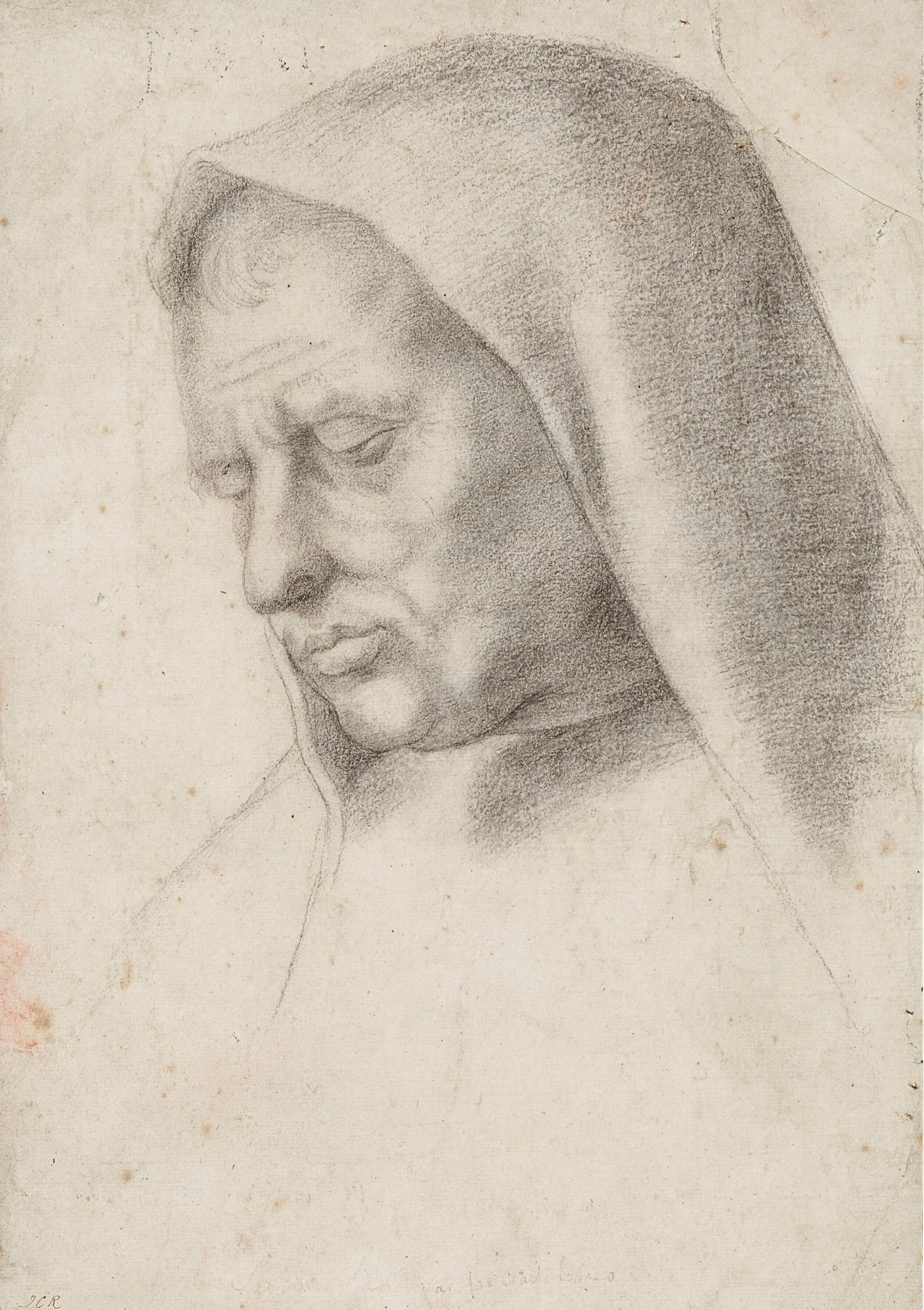
SUOR PLAUTILLA NELLI
(Florence, 1524 – 1588)
Head of a Friar (after Fra Bartolomeo)
Black chalk on paper
13 ⅛ x 9 ⅛ inches (33.5 x 23.4 cm)
Provenance:
Robert Prioleau Roupell (1798–1886), London (Lugt 2234); his sale:
Christie’s, London, 12 July 1887, lot 719, as Fra Bartolomeo, Head of a monk.
Sir John Charles Robinson (1824–1913), London (Lugt 1433).
With Parsons and Sons, London.
Sotheby’s, London, 25 February 1948, lot 82.
With Hans Calmann (1899–1982), London.
With Mrs. H. de Beer.
With Colnaghi, London.
With Frits Lugt (1884–1970), Paris.
Gerald Guterman, New York.
Christie’s, New York, [1] February 2024, lot 1; where acquired by:
Private Collection, Germany.
Literature:
Jean-Luc Baroni, Paintings, Sculptures, Drawings, London, 2014, pp. 96-101, under cat. no. 29, ill.
The workshop legacy of Fra Bartolomeo has remarkably and famously survived unlike that of any of the artist’s contemporaries. At his untimely death in 1517 at age 44, the contents of his workshop—883 sheets with drawings, as well as paintings, wax models, tools, sketchbooks, mannikins, and artist’s materials—passed to his fellow artist and friar at the monastery of San Marco, Fra Paolino da Pistoia. At Fra Paolino’s death in 1547, these holdings were given to the convent across the piazza from San Marco, Santa Caterina da Siena, and specifically, according to Giorgio Vasari, to “una monaca che dipinge” (“a nun who paints”), Suor Plautilla Nelli.
Around 1725 the Florentine collector Francesco Maria Niccolò Gabburri read this passage in Vasari’s Lives of the Artists and went to the convent, inquiring after the then-forgotten drawings. He purchased most of them from the nuns and mounted many of the loose sheets into two albums, comprising a total of 400 sheets of drawings on 389 pages. After passing through several notable collections (among which were those of Benjamin West, Sir Thomas Lawrence, and King Willem II of the Netherlands), the albums arrived at the Museum Boijmans Van Beuningen in Rotterdam, where they now reside. The balance of the frate’s workshop materials that had been in Plautilla Nelli’s care were dispersed over the centuries, with significant drawings now in the Uffizi, the Louvre, and various other museums and private collections.
Plautilla Nelli had a rich practice as a draughtswoman, but very little of her graphic oeuvre has survived. Only a small group of drawings in the collection of the Uffizi have been attributed to her.[1] Following her early training as a miniaturist, perhaps the most consequential chapter of Plautilla’s artistic and stylistic development came with the arrival of Fra Bartolomeo’s and Fra Paolino’s workshop contents to her convent. She turned her attention to panel painting and began her lifelong engagement with the vast group of drawings, which had a profound influence on her art. Not only did they provide a training ground for Plautilla to refine her hand, but they also served as a significant body of source material that she mined for her own compositions throughout her career.
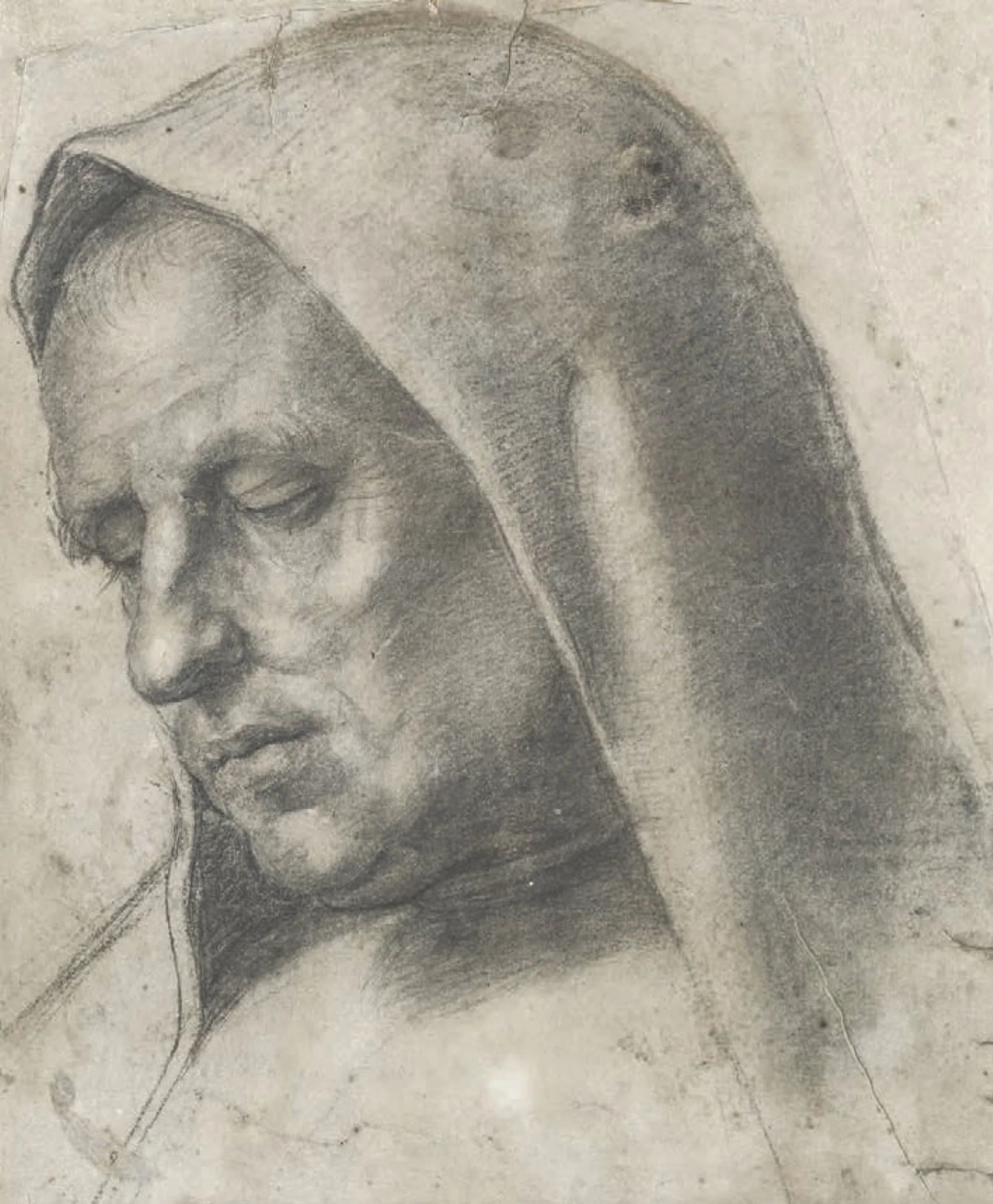
Fig. 1. Fra Bartolomeo, Head of a Monk, Private Collection.
The drawing presented here is an early copy of a powerful Fra Bartolomeo life drawing of a monk that was recently on the art market (Fig. 1). The latter was once in the possession of Sir Thomas Lawrence and likely came from the same Gabburri holdings of Fra Bartolomeo’s drawings, although it may have been separated from the albums early on as it was believed to be a portrait of Savonarola by Raphael.[2] Coincidently, both this sheet and the Rotterdam albums were sold from Lawrence’s collection via his agent, Samuel Woodburn, to The Prince of Orange (later King William II of the Netherlands) in October 1840.[3] The portrait drawing was later auctioned separately from the albums and has remained in private hands.
The present work, which may have conceivably also belonged to Gabburri, is of almost the same size as Fra Bartolomeo’s head study.[4] It is, however, executed in a different technique—one that can be confidently associated with Plautilla. In comparison to the bold modeling of the original, this copy is characterized by softness in the handling of the chalk and stumping, as well as tentative hatching, which find close parallels in some of the drawings given to Nelli in the Uffizi. Notably, several of the distinctive facial features in this drawing are treated analogously in Plautilla’s paintings. The heavy, lidded eyes; the prominent, rounded chin; and the puckered lips can be found in her various depictions of the Virgin (Cats. 11-12; Figs. 2-4). The work may have been produced as a drawing exercise by Plautilla, as the head does not appear in any of her known paintings.
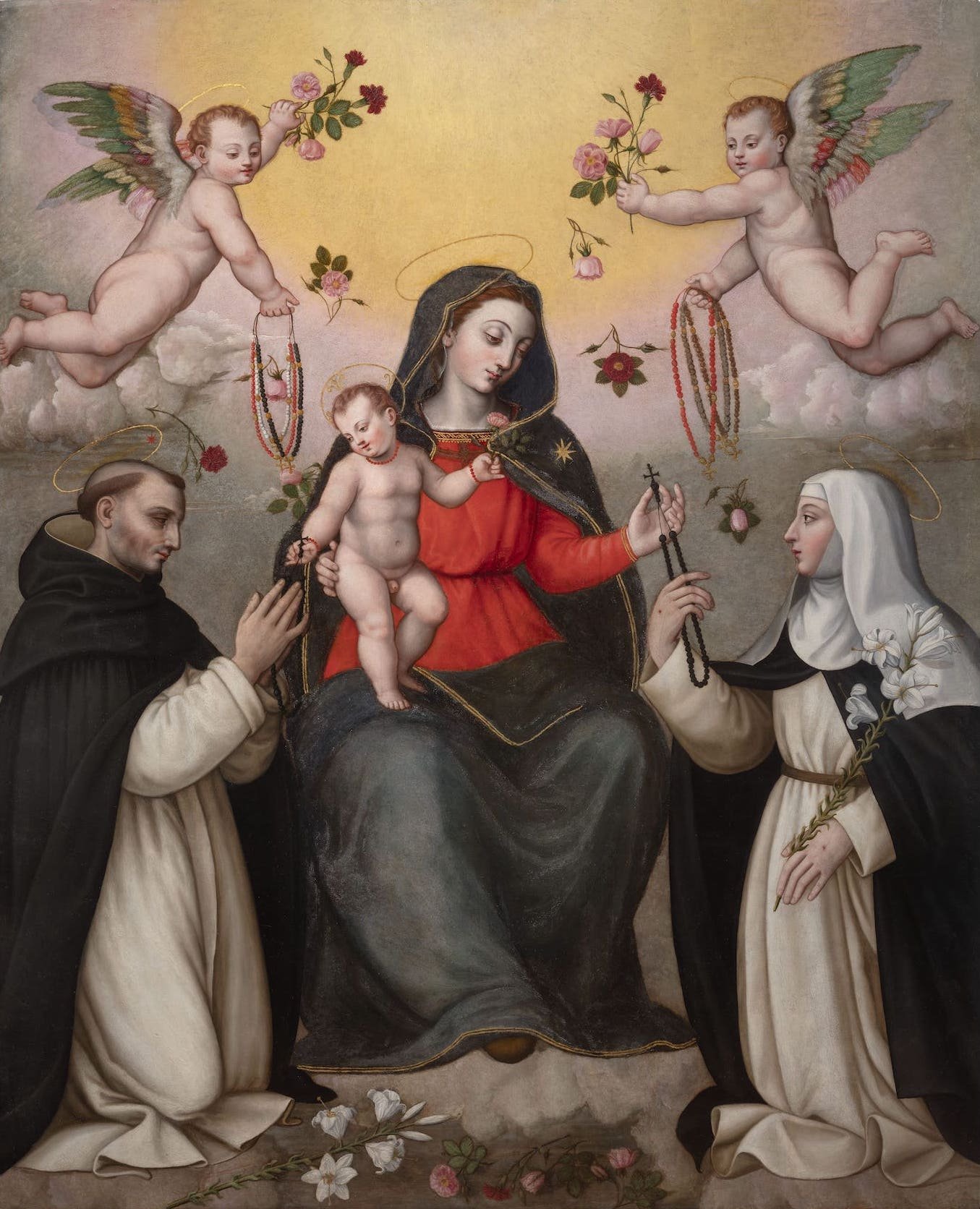
Fig. 2. Plautilla Nelli, Madonna of the Rosary, Chiesa dei Santi Giuseppe e Lucia, Montaione.

Fig. 3. Detail of Plautilla Nelli, Madonna of the Rosary, Chiesa dei Santi Giuseppe e Lucia, Montaione.
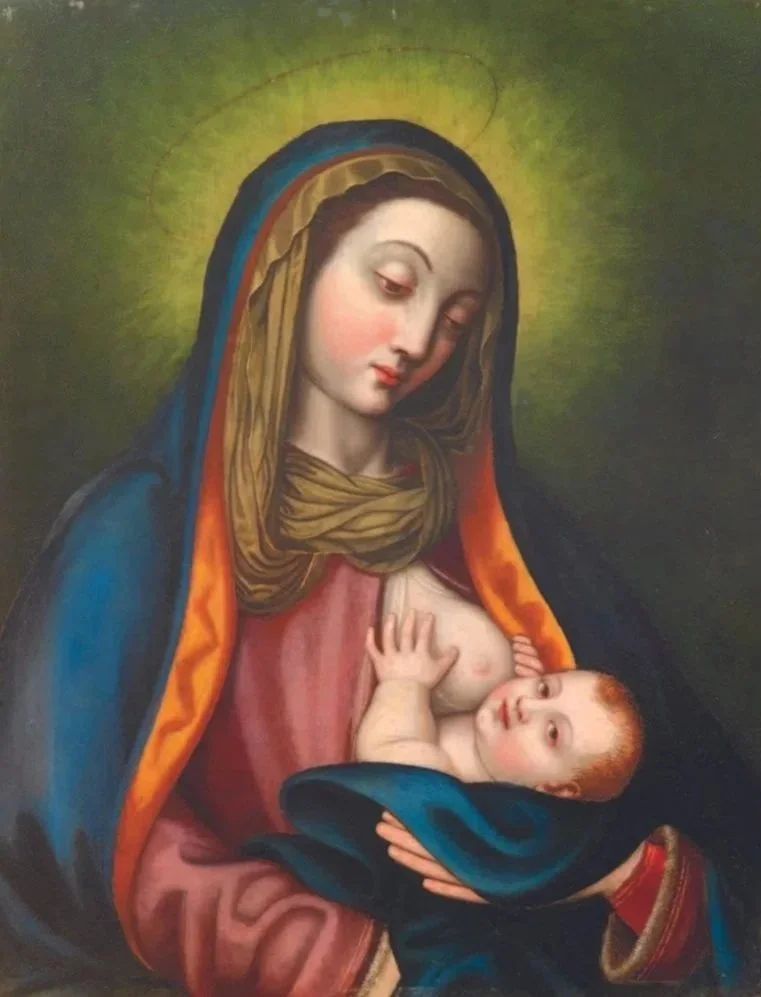
Fig. 4. Plautilla Nelli, Madonna del Latte, Private Collection, Italy.
A recent re-examination of the Fra Bartolomeo drawings in Rotterdam has shed further light on Plautilla’s engagement with this corpus.[5] Two sheets include sketches that are here tentatively attributed to Plautilla or her workshop. The first, inv. no. I 563 N 142 Verso (Fig. 5), depicts the Virgin Mary kneeling with her hands held together in prayer—a pose close to that found in the Adoration presented in this exhibition (Cat. 1). This rudimentary drawing was done on the reverse of Fra Bartolomeo’s study of a tonsured monk, inv. no. I 563 N 142 Recto. The second example, inv no. I 563 N 91 Recto (Fig. 6), involves the interpolation of two tentative sketches—one of the Virgin’s head and one of the Virgin and Christ child’s heads together in different orientations—to a sparsely populated sheet of figural studies by the frate. The additions of these drawings to the blank reverse of one sheet and the vacant space of another is perfectly befitting the economy of means of Plautilla and her workshop of nuns.[6] Alongside the Head of a Friar, these drawings further enrich our understanding of Plautilla’s practice as a draughtswoman.
Sixteenth-century portrait drawings are extremely rare survivals, and a drawing of this kind by a significant woman artist of the period even rarer still. Here Plautilla has translated the immediacy of Fra Bartolomeo’s study into a work that reflects her own, highly personal style.
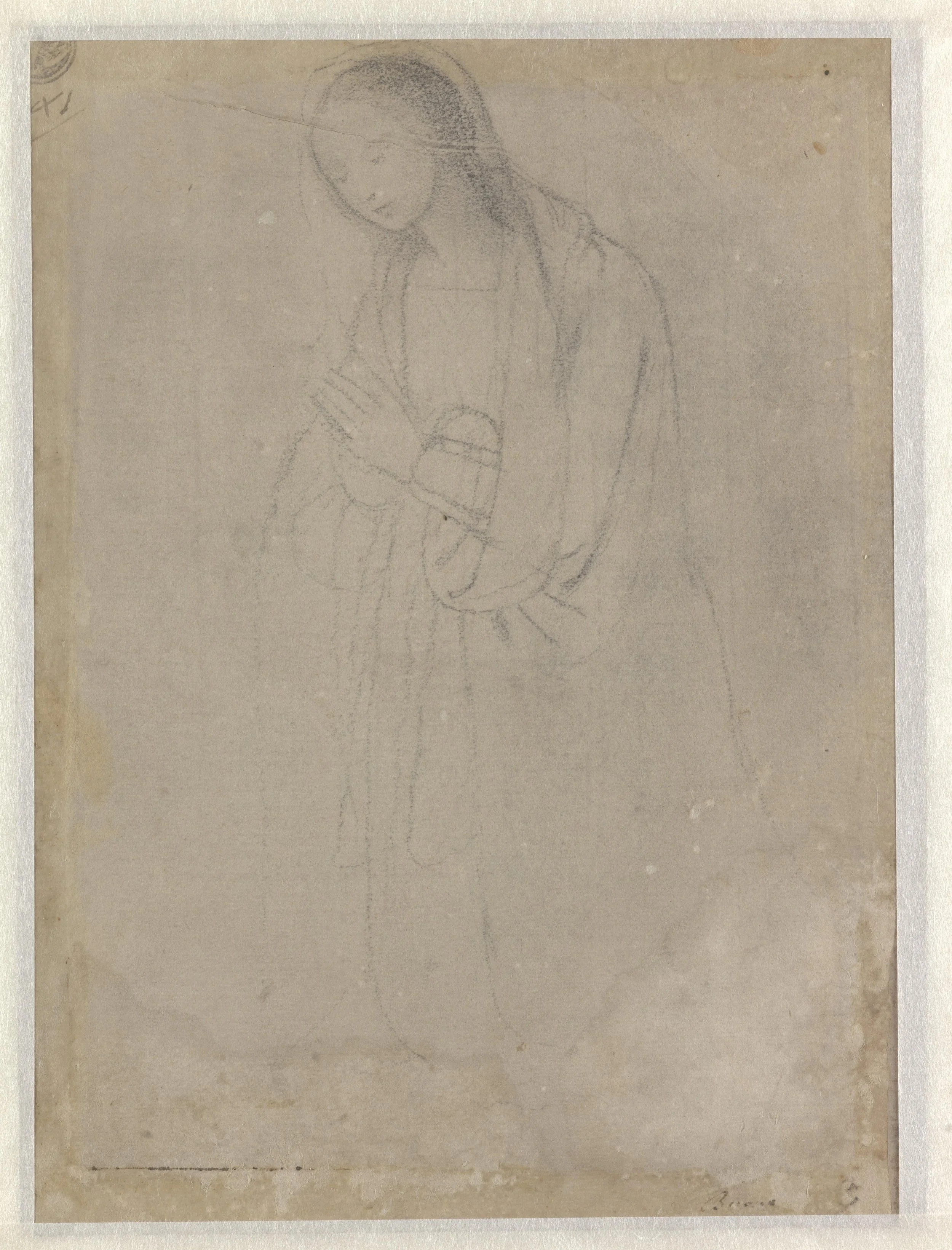
Fig. 5. Attributed to Plautilla Nelli, Virgin Mary in Prayer, Museum Boijmans Van Beuningen, Rotterdam.
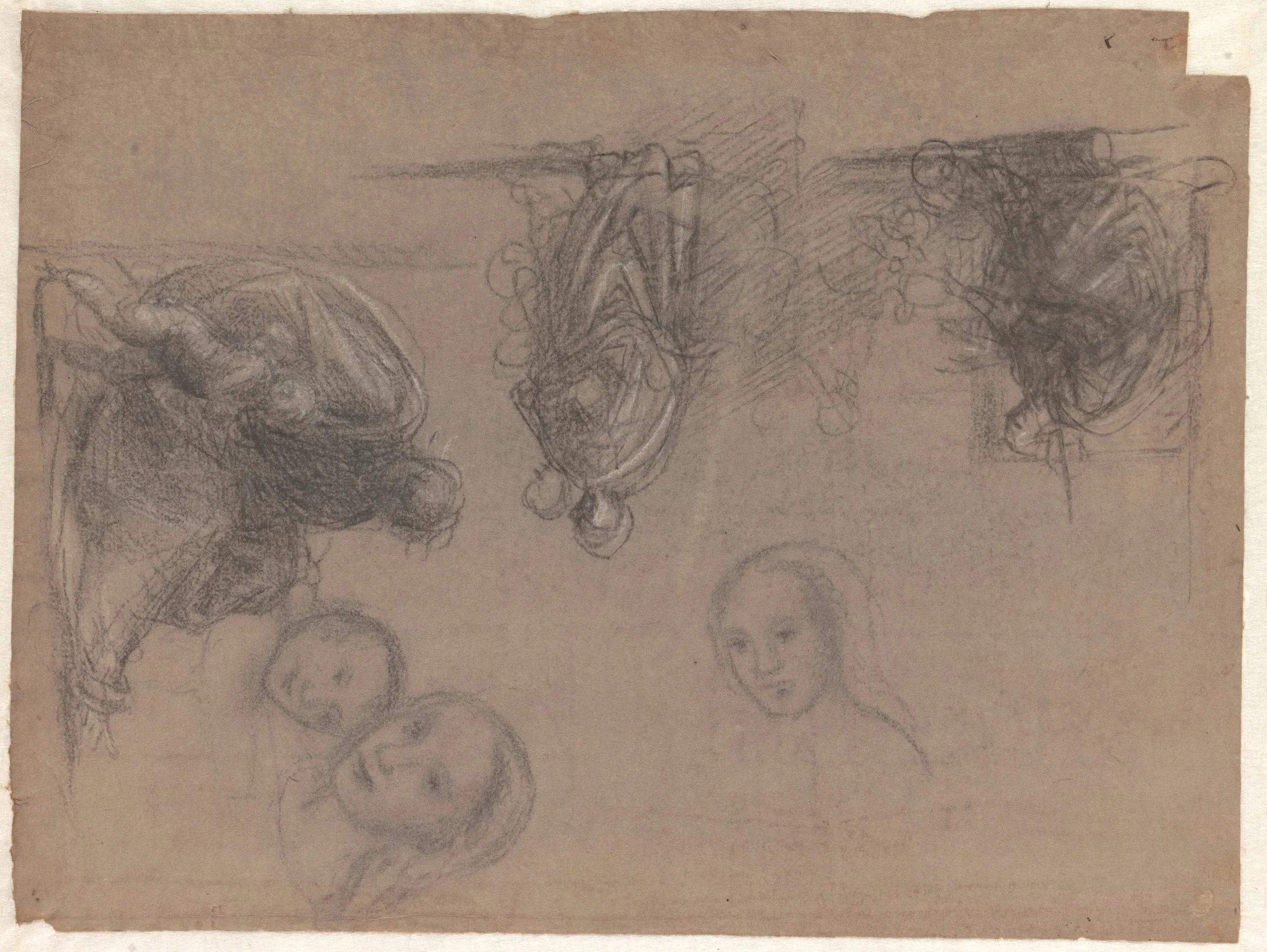
Fig. 6. Fra Bartolomeo, Figure Studies, with additions of the Virgin Mary and the Christ Child attributed to Plautilla Nelli, Museum Boijmans Van Beuningen, Rotterdam.
[1] Michele Grasso, “I Disegni di Suor Plautilla Nelli agli Uffizi / Suor Plautilla Nelli’s Drawings in the Uffizi,” in Plautilla Nelli: Arte e Devozione sulle Orme di Savonarola / Art and Devotion in Savonarola’s Footsteps, ed. Fausta Navarro, exh. cat., Livorno, 2017, pp. 120-141. Most of these drawings have been attributed to her on the basis of identifying inscriptions by Filippo Baldinucci, who reorganized the Medici drawings collection in the 17th century.
[2] Jean-Luc Baroni, Paintings, Sculptures, Drawings, London, 2014, pp. 96 and 98. For a discussion of Niccolo Gabburi’s acquisition of the Fra Bartolomeo drawings and assembly of albums M and N, see: Albert J. Elen, “Out of Oblivion: An Extraordinary Provenance,” in Fra Bartolommeo: Divine Renaissance, ed. Albert J. Elen and Christ Fisher, Rotterdam, 2016, pp. 46-49. Gabburri likely purchased the drawings as loose sheets, perhaps in portfolios, from the nuns. The albums seem to be mostly intact, but there are slight differences in the number of drawings in the albums described in Gabburri’s inventory versus the total numbers as they survived by the time they arrived in Rotterdam, suggesting that some drawings could have been removed.
[3] Messrs. S. W. Woodburn, A Catalogue of Drawings by the Old Masters in the Possession of Sir Thomas Lawrence, P. R. A. at the time of his death (7th January 1830), 1834 (Ms., bound, London, Victoria and Albert Museum, National Art Library, ref. no. MSL/1870-1-18, p. 49, under Raffaelle, in Case 5 Drawer 2, no. 310, as Portrait of the Monk Savonarola).
[4] It is not known whether the present sheet might have once belonged to Gabburri or if it could have been separated from the group formerly at Santa Caterina da Siena at an earlier date. The inventory of Fra Bartolomeo’s estate, drawn up by the painter Lorenzo di Credi in 1517, lists nearly 1000 individual sheets with drawings and 12 sketch books comprising an additional 180 sheets of drawings, among others. See: Elen, “Out of Oblivion,” p. 43. By the time Niccolò Gabburri purchased the 400 sheets now at Rotterdam (and others) from the convent of Santa Caterina da Siena ca. 1722, some of Fra Bartolomeo’s drawings at the convent were lost or sold off by the nuns. Gabburri references this in his disparaging comment about the nuns in the title page of the surviving albums. He describes the drawings: “furono comprati dalle medesime Monache a fine di conservareli, perche non facesero per quant è possibile l’istessa fine che anno fatto tanti, e tant’altri Disegni di quest’Autore che per lungo corso d’anni sono stati condannati dall’imperizia di quelle Madri, a rinvoltare miserabilmente le crazie” (“I purchased them from the nuns in order to preserve them, so that they would not, as far as possible, suffer the same fate as so many other drawings by Fra Bartolomeo, which, over the course of many years, had been condemned by the incompetence of the nuns, who unfortunately used them to make parcels for crazie.”). The reference to crazie—small denomination coins used in Florence which might have been given as offerings to the convent—further demeans the nuns for their use of precious drawings to wrap something that Gabburri perceived to be of little value. See: https://www.boijmans.nl/en/collection/artworks/58962/title-page-of-gabburri-album-m.
[5] I would like to thank Rosie Razzall, Esmé van der Krieke, Penney Rombouts, and Milou van der Stel of the Museum Boijmans Van Beuningen for facilitating my visits to study the drawings at the Depot.